

STORIES
Cupid and Psyche – an ancient myth re-imagined
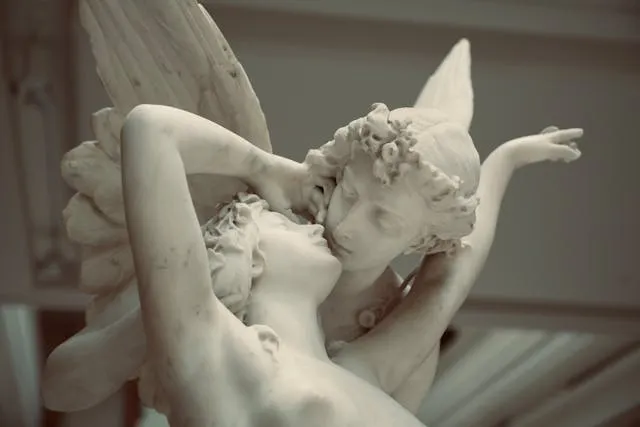
The main source for the myth of Cupid and Psyche, on which several folktales including Beauty and the Beast is based, is the second century AD work, The Golden Ass by Lucius Apuleius, in which the protagonist is transformed into an ass. The story below is a modified extract from my novel, An Ass’s Tale, loosely modeled after Apuleius’ work. Here is a brief summary of the myth:
Venus, angered by the attention given to a young mortal, Psyche, for her beauty, bids her son, Cupid, to make her fall in love with someone repulsive. Cupid happens to prick himself with one of his arrows, and becomes Psyche’s lover, but doesn’t allow her to learn his identity. Psyche’s jealous sisters convince her that her mysterious lover is a monster that will murder and eat her and her unborn child, and urge her to kill him. About to do so as he sleeps, she sees his face and accidentally pierces herself with his arrow. Cupid awakes and flees. Inconsolably in love, she seeks him out, enduring many hardships, even journeying to the underworld. Finally, her true love proven, she is reunited with Cupid and becomes immortal. The tale is said to symbolize the soul’s journey to divine love.
The narrator of my novel is the ass and for the sake of clarity I have italicized his lines to set them off from the rest of the story.
Tethered to a stake, I was contentedly nibbling some long grass, when the couple emerged from the house and plopped a basket down on a blanket not far from me. In short order, they were enjoying an alfresco lunch, and, as they ate, Deirdre pulled a small book from the basket and began reading aloud to her husband, picking up, apparently, where she’d left off earlier. I had no choice but to listen. In that warm, melodious voice I loved so well, she read:
Verna and Glen were in their mid-thirties, when Harry was born. They had two other children, both girls, aged nine and four. When Violet, the older one, was born, they didn’t know a thing about raising kids, and read all the books they could get their hands on for guidance. They paid close attention to every detail of Violet’s physical and mental development, anxious about any deviation from what was set forth in the parenting books.
They fretted about whether it was better for the baby to sleep in her crib or with them; whether to allow her to cry at night or to pick her up every time she fidgeted; whether to give her a pacifier the moment she started to fuss or discourage its use; when to start her on solid food; how and when to potty train her, and a million other matters. The experts often disagreed about these and other matters. The anxious couple came across advice supporting opposing sides of every question they had, and were never sure if they were doing the right thing. Other parents offered their own recommendations and predictions of dire consequences if their instructions weren’t heeded. They never let Violet out of their sight and woke up during the night to check on her. They were loath to allow anyone else to look after her, even for the shortest time, and rarely entrusted her to a babysitter.
It was different when Annette was born five years later. Having already been through it all, they knew the ins-and-outs of child-rearing, and relied on the practices and strategies that worked in the past. They rarely sought advice, didn’t worry about every little thing, and parented in a more casual and relaxed way. Having survived the process once, they thought of themselves as pros, and didn’t hesitate to share their expertise with other expecting parents. Raising their second child was a lot simpler and less stressful than raising the first.
When Harry came along four years later, they had even less concern about caring him. At that point they considered themselves experts at parenting, and it never occurred to them to consult anyone about any aspect of their son’s rearing. Also, their situation had changed. Only Glen was employed when the two older children were born, but now Verna was working and focused on her career. Fortunately, the two older girls were there to help take care of their little brother. By the time Harry turned three years old, his parents had divorced, and his mother had custody of all three children. Glen was pretty much out of the picture and the kids didn’t have much contact with him from that point on. Mostly everything they heard about their father was from their mother’s lips, and it wasn’t very favorable. The children became accustomed to their mother’s frequent tirades about their father and men in general.
Despite the changed circumstances of the family, there wasn’t a big difference in how the girls were raised and how Harry was brought up. He had, of course, different kinds of toys to play with. While the girls had dolls and doll houses, tea sets and fluffy animals, Harry had toy cars and ships, a train set, cap pistols, bats and balls. If his mother was a little more distant towards him than she had been towards his siblings, it was because she was older and more involved in her own work-related concerns. Generally speaking, the Brewsters were a typical family and to any outside eye nothing would have seemed amiss. It wasn’t until Harry turned thirteen that anything out of the ordinary became apparent, and his mother remained oblivious long after others started whispering about him.
The relevance of his upbringing to what happened next is debatable. How much or little is attributable to how he was raised depends on one’s outlook and beliefs. Adolescence is always a difficult phase, and it was especially hard for Harry, not least because his family moved when he was starting eighth grade. They relocated to a distant city and he attended a new school where he didn’t know anyone. His sisters had already left home. The older one was married and the younger one was off at college. So Harry was pretty much on his own without any of his old friends or support systems.
School was rough for him, and not just because he was the new kid. He was rather frail-looking, and so, a tempting target for bullies. The kids he grew up with had accepted him, but the strangers in his new school had no regard for the odd newcomer. His quiet and unassertive ways branded him as a sissy, and kids called him fairy, faggot and queer. He was too embarrassed to tell his mother about how he was treated, and besides, what could she do about it? He had no one to confide in. He hated school and each year things got worse. His grades deteriorated along with his self-esteem. He was an outcast.
During his junior year, when he was home alone, he started going into his sister Annette’s room and spending time among the familiar things there, which calmed and comforted him. He had a special affinity for her clothing. At first, he would just stroke them for their softness and hold them to his cheek, but after a while he began trying on her blouses and skirts. He told himself it was because he missed his sister. Eventually he put on her undergarments as well, even her bra, filling the cups with socks. He applied lipstick and makeup to his face and experimented with different ways of arranging his long hair.
Before long, it became his daily routine to dress up in his sister’s clothes as soon as he returned from school, and keep them on until just before his mother was due home. When he looked in the mirror he didn’t see the weak little boy that was tormented in school, but an attractive and seductive young woman. In this attire he would do his homework and various chores around the house. His homework assignments improved significantly when he did them dressed as a charming young woman rather than in the guise of his loser self.
One afternoon, while he was decked out in his sister’s finery, the doorbell rang. He hesitated, and then decided to see who was there. It was a young man soliciting donations for a charity. Harry opened the door, and the fellow who stood there appeared flustered and a bit tongue-tied. Harry was amused at the man’s reaction to the pretty, young woman in front of him. After a few inane remarks, the poor guy seemed to totally forget the reason for his visit and began unabashedly flirting. It was the first time Harry had let another person see him dressed in women’s clothes, and he felt a new sense of power. He was more himself, more comfortable, than when he wore his own clothing.
Some say nature is the determining factor of a person’s character, others nurture. Maybe it’s a combination of the two. Whether it was because he was raised with and partially by his two sisters in an all-female household, or because he was genetically predisposed more towards femininity than masculinity, is a matter of conjecture, but Harry didn’t develop strong male characteristics. He didn’t have facial hair like most of his male peers, and his cheeks were covered only in a peachy down. His physique resembled that of a girl more than a boy, and while he was more comfortable in the company of girls, he was attracted to boys.
Harry read everything he could find pertaining to his peculiar condition, and in time came to the conclusion that he was born into the wrong body. He was a girl in every respect except for the fact that he had a penis and was classified as a male. He wasn’t male in temperament or physique, and his life as a male was a total failure. With the help of a few accouterments, he transformed himself from a being he loathed into one he took pride in. As a male, he was mistreated by everyone around him and felt at odds with his own body. As a female, he saw himself as beautiful and desirable. His research confirmed his own feelings, and he decided that when he was able, he would follow in the footsteps of Christine Jorgensen and do what was necessary to become what he was supposed to be in the first place.
Once his situation was clear in his own mind, he began to go out in public with elements of female attire. He started out by wearing a pale shade of lipstick, hardly noticeable unless one was attuned to that kind of thing. Then he plucked his eyebrows and repainted them. Some of the kids at school noticed, but surprisingly, it didn’t result in more bullying. He’d been mocked as a homo before, but his new look gave him a more dangerous image. The kids that used to pick on him kept their distance. He was too abnormal for them. Something about him scared them. At the same time, some of the girls who had never paid him any mind, started befriending him, and before long he was borrowing articles of clothing from them and dressing in an increasingly feminine way.
At home, his mother, preoccupied with her own concerns, was unaware of any change in her son until winter break when Annette came home from school. After spending a few minutes in her room, she went downstairs and started complaining that her drawers and closet were all disorganized and some of her things were missing. Her mother shrugged her shoulders, assuming that her daughter had just forgotten how she had left things. Annette stormed into her brother’s room to ask if he had let any of his friends into her room, but he wasn’t there.
She stared into the room, taken aback by how neat it was. Not what you’d expect from a teenage boy. Curious, she opened the closet door to see if Harry was as careful with what was out of sight as he was with the room’s appearance. Apparently he was. Everything was organized and tidy. She was impressed. Idly, she pulled open a dresser drawer and saw that even there the clothing was neatly folded. She was just about to shove the drawer shut when a familiar piece of fabric caught her eye. She lifted it out and uttered a gasp. Then, she started digging around in the drawer, pulling out all the contents and throwing them on the bed. There were blouses, skirts, dresses and undergarments, some of which she recognized as her own. At the bottom was a stash of lipstick, makeup, eyeliner and mascara. She stood there a moment with her mouth open and then screamed, ‘What the hell are you up to, you little pervert?’ The commotion brought her brother and mother to the door of the room, and that was how Harry’s secret life was discovered.
It was a difficult holiday season for the Brewster family that year. Christmas Eve was a blur of yelling and recriminations. Harry’s mother accused him of bringing shame on the family. Violet and Annette blamed their mother for not paying attention to what was going on with their brother. Harry tried to explain what was happening in his life and what his plans were. It was a wretched Christmas Eve for everyone, and they all went to bed feeling angry and in anything but a holiday spirit.
The next morning, Harry woke up early and took pains getting himself ready. He applied foundation to his face and added color with rouge. He attached eyelash extensions and put shadow on his eyelids, quietly humming Lou Reed’s immortal doot, di-doot, di-doot refrain as he worked. He painted his lips with crimson gloss. Then he selected the most exquisite clothing he could find and dressed himself with care, finishing off with sheer hose and red pumps. Attired in this fashion, he sashayed down the stairs to greet his mother and sisters who were sitting around the dining room table talking earnestly. When they saw him, their jaws dropped.
“Oh my God!” gasped his mother.
“I can’t believe it,” echoed Violet, her hand over mouth. “He’s gorgeous.”
“He puts the rest of us to shame,” agreed Annette.
When they saw him in all his glory, they understood what he’d been trying to tell them. He was a woman, not a man, and it was ridiculous to try to deny it. They decided that morning that they would do whatever it took to help him make his transformation permanent and official.
Before the next Christmas came around, Harry had become Harriet, and in that new guise went off to college. Life for Harriet was very different than it had been for Harry. Instead of being ridiculed or ignored, she was admired wherever she went, the embodiment of grace and style, always in demand. With her change in looks came an equivalent change in personality. She was no longer shy and introverted, but the life of every party. She had experienced a rebirth, and she could never cease marveling at how differently people are treated solely on the basis of their looks.
I thought that Deirdre had come to the end of the tale and started to wander off in search of a new patch of grass, but she’d only paused to take a few bites of food, which her reading had caused her to neglect. As soon as I realized there was more to the story, I moseyed back to where I’d been.
Harriet had admirers, but no real boyfriend until she met Leroy. Though she was thoroughly at home in her new body and identity, she was hesitant about engaging in sexual activity with another person, never having done so either as a male or female. Her beauty made it easy for her to reject unwelcome advances and keep potential intimacy at bay. Would-be suitors retreated if they were rebuffed, thinking it was because they were out of her league. But with Leroy, the barriers began to crumble. He was uncommonly handsome with well-defined, chiseled features and a strong, muscular build—and he had the self-assurance and swagger appropriate for such a figure. She was excited by the touch of his dark brown hand on her ivory white arm. It wasn’t just a physical attraction. Leroy’s life had its share of pain and adversity. Hearing about the challenges he faced, and the struggles that defined his life, she was drawn closer to him. Harriet, as beautiful and successful as she was in her new incarnation, remembered the hardships and degradation she faced in her old persona, so she was sympathetic to Leroy’s travails as a black man in America. The courtship was slow and cautious, but in the end they became lovers.
Love is a curious thing. Who knows what it is that makes one individual irresistible to another? Need and longing for something lacking in one’s self is the basis of many relationships, and undoubtedly played a role in the love Harriet and Leroy felt for each other. Each provided something the other yearned for. Whether it was something real or just perceived, the longing and passion were equal on both sides. That distinguished their relationship from many others, which were transparently asymmetrical and lopsided, with one partner being dominant.
When Harriet and Leroy became a couple, there was consternation among various groups of people, because two attractive potential mates had become unavailable. The racial differences of the couple only intensified the jealousy of disappointed admirers, who were scandalized at being bested by someone of another race. Strangers sometimes marveled at the strikingly beautiful couple, but those closer to them, stung by envy, often tried to sow seeds of discord. Harriet’s white friends gossiped about Leroy’s disreputable family, and how his father abandoned his mother shortly after he was born, and how his younger brother, from a different father, was behind bars. Leroy’s friends and relatives rebuked him for getting involved with a white girl, and warned him that he would regret it. But the two were deeply in love and ignored the chatter around them. They both genuinely felt that the other made them whole. When they lay in each other’s arms, they a enjoyed a bliss they hadn’t known before.
Harriet’s only uneasiness stemmed from not telling Leroy about her gender transformation. Before they were physically intimate, there was no compelling need to talk of such things. But once they were, it became harder for her to say anything to him about it. She loved him and knew that he loved her, but that just made it more difficult to reveal her secret. Criticism and ostracism due to their cross-racial relationship couldn’t place a wedge between them, but how would Leroy react to the news that his darling girl used to be a boy? That revelation could very well scare him away, and that possibility terrified her. Feeling that she couldn’t live without him, and wasn’t willing to risk losing him, she constantly debated within herself whether and how to tell him. It wasn’t a secret she wanted to keep from him, but one she dared not divulge. That was the cause of the tiny rift between them that both were aware of. Leroy assumed it was due to vestigial racial qualms, and never suspected that Harriet was concealing a secret she feared could alienate him from her if he discovered it.
Outside forces attempted to rip them apart and disrupt their perfect love. Leroy’s family told him over and over again not to trust the white girl, to keep their own kind. Harriet was hesitant to tell her family about Leroy because she didn’t think they’d react well to the idea of her dating someone of a different race. Still, when her mother pleaded with her to come home for Thanksgiving dinner, she remembered how her family came around and supported her sexual transformation, and decided to accept the invitation. It seemed like a good opportunity to let them know about him, and said she would bring her boyfriend. “Just so you know,” she said, “his name is Leroy, and he’s not white.”
Violet and her family were already there along with Annette and her fiancé when Harriet and Leroy drove up to the house. The turkey was still in the oven and everyone was bustling about preparing for the meal. The dinner conversation was polite and banal. Harriet, relieved by her family’s acceptance of the situation, felt that that potential obstacle to her happiness had been hurdled. Ducking into the kitchen after dinner to ready the dessert for serving, she thought that things couldn’t have gone better. A few minutes later when she walked back into the dining room with a pecan pie in her hands, it seemed unusually quiet. She looked around and saw Annette sitting on the sofa beside Leroy. On the coffee table in front of them, the family photo album lay open. The breath went out of her, and she ran back into the kitchen, tears streaming from her eyes. A minute later she heard a door open and slam shut and then the sound of an engine. Leroy had driven off without her.
Since she ceased being Harry, Harriet hardly knew a moment’s sadness, but the misery she experienced now eclipsed anything in her earlier existence. She was furious with her family for betraying her. She knew that in their own warped way they’d done what they thought was for her own good, but they’d ruined her life. Towards Leroy she felt shame for having concealed the truth about herself, and anger that he deserted her. His love wasn’t strong enough, and that was a bitter disappointment. On the phone in the kitchen, she called a taxi to take her to the bus station, and as soon as it arrived, she bolted from that hateful house without saying a word to anyone. All she thought about during the five hour journey back home was how much she longed for Leroy, and how empty she felt. Life wasn’t worth living without Leroy.
Dark, contradictory thoughts passed through Leroy’s mind as he drove back home on that cold November night. He was overcome with revulsion to find that the girl he’d fallen in love with wasn’t really a girl. His blood boiled at the enormity of the trick played on him, and he was ashamed of himself for being taken in. How she must be laughing at what a fool she made of him! Maybe he didn’t actually believe that, but it’s what people would say. He’d be an object of derision among friends and family, and wouldn’t be able to show his face. He’d have to go someplace far away where nobody knew him.
His anger was so fierce that he didn’t recognize, at first, that it contained a morsel of guilt. He’d believed his love for Harriet was unconditional, absolute, but now he had rejected her absolutely. Was everything he’d felt, everything he thought he felt, a lie? Why had she deceived him? But had she told him she’d been born a boy, would he have been able to go on loving her? He pretended that he was angry about her dishonesty, but he knew it was also because of his inability to accept her for who she was. If he had a secret like that, would he have had the courage to reveal it to Harriet? Uncertainty about himself increased his wretchedness, and in this he was not unlike his soulmate. Both were uncertain of the real character of the person they loved, but also of who they themselves were. They longed for the one person who could assuage their misery, who was also the cause of that misery.
Having become engrossed in the story, I was incensed when the two finished eating, got up from the table, and started back toward the house. Deirdre continued reading as they walked, but her voice became fainter and fainter until I couldn’t hear it at all. All I could glean before her words became inaudible was that Leroy disappeared and Harriet set out to search for him. I stamped my foot in frustration, but there was nothing I could do. I would never know how the story ended. It didn’t make any sense for me to chafe over not knowing how things turned out, since I didn’t even know if the story was true or a piece of fiction. Still, I felt cheated about missing the rest of it. A sense of unfinished business lingered annoyingly in the back of my mind, and I couldn’t decide if I would have been better off never hearing the story in the first place than hearing what I did without knowing the resolution.
December, 2025