

STORIES
A Matter of Identity
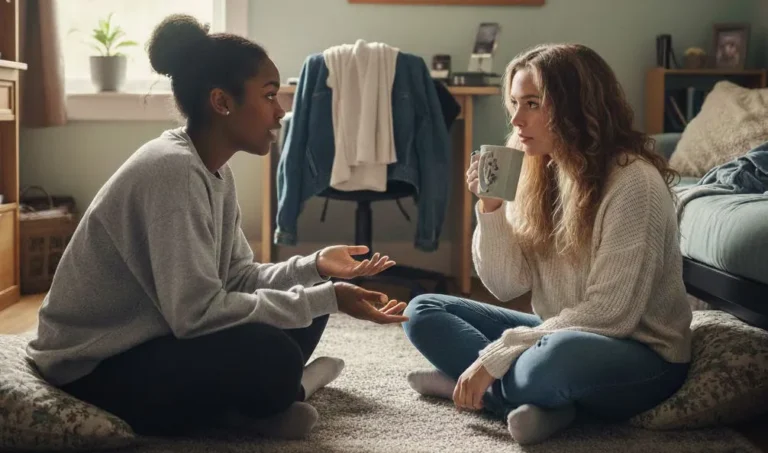
Don’t worry,” Nellie said, taking hold of Julie’s hand. “Your secret’s safe with me. I won’t tell a soul.”
“It’s not exactly a secret. I just didn’t want to advertise it. I wanted people to get to know me as myself, not as the Jewish girl.” She struggled to explain that her Jewish identity never suited her and felt like a garment someone had thrust on her and expected her to wear, even though it didn’t fit and caused her to trip and feel clumsy. All her life, she’d worn it dutifully, and now she was trying to cast it off so she could be her real self. Why be saddled with a cumbersome identity that only got in the way and served no real purpose?
“Of course. I know how you feel.” She let go of Julie’s hand and stretched both her hands out in front of her. “I wonder what it would have been like to shed my black skin before coming to college so that people would know me as Nellie, not the Black girl. But it’s kind of hard to keep skin color a secret, so not much choice there. You’re coming to a new place and want to re-create yourself. Good for you!”
Julie’s face took on a worried look. “You must think I’m awful, Nellie, turning my back on my, um, heritage like that. When you talk about not being able to change your skin color, it makes me feel crass about rejecting my Jewish background. I shouldn’t deny who I am.”
“And who are you? A Jew? Or Julie? You may have Jew in your name and background, but that doesn’t define who you are.”
“It’s confusing. I don’t feel a connection to any Jewish community or the Jewish faith, so why should I be called Jewish? I feel mislabeled. I just want to be myself, but it feels dishonorable to hide the fact that I’m Jewish. You accept who you are, and I should do the same.”
“Like I said, I have no choice. If I go around pretending my skin ain’t black, people would just call me nuts. Well, they probably do anyhow. But my Blackness isn’t just in my skin. It’s in the way I was brought up, the way people look at me, the cultural norms I’ve absorbed. It’s not something I can run away from, because there’s no place to run to. Look-it, you and I were born in female bodies. We don’t necessarily want people to see us as females. Not that we want to be males. We just want to be ourselves first, female second—or maybe third or fourth—in the identity hierarchy. We could go for an androgynous look to avoid gender identification, but that doesn’t work either because we’d just get called andros, and that’s just as bad or worse, because we’d be drawing attention to the very thing we’re trying not to emphasize. The question is, how can we be ourselves without those annoying, identifying labels?”
“What’s the answer to that question?”
“We each have to figure that out for ourselves, and not just once, but continually, because we change, and the world around us changes. I think of myself as Nellie, but others see mostly a part of me—my blackness, gender, age, nationality, major, or something else. Of course, I have special affinities with the people I share such commonalities with. I even admit to a special closeness with people from the same small town in South Carolina where I was born, but who I am isn’t defined by any of the traits I happen to share with others. Parts of me come from my genetic makeup, where and how I was raised, every person I’ve met, every experience I’ve had, every book I’ve read, every movie I’ve seen, and on and on. People may want to capture, or as you say, label me, as one particular thing, but too bad for them, because the real me transcends all those separate parts, and isn’t contained or explained by one or any combination of them.”
“So you don’t care what people think of you?”
“I wish! I can’t help caring about that, but since I can’t really control how people see me, or what they think of me, I try not to. Some Black people might want me to think and act a certain way, just like some English majors want me to speak and carry myself in a certain way. Lots of White folks have expectations about me before they’ve heard a word from my mouth or know a thing about me. But that’s their problem, not mine. Too fucking bad if I don’t fit the stereotype. Nobody actually does, even though some people go all out trying.”
“You’re so liberated, Nellie.”
“Liberated isn’t something you are. It’s something you struggle constantly to become. I do the best I can to be me, but I come up short all the time. Life isn’t easy for anyone, and it sure isn’t easy for an African American woman. I could act fierce like some people I know, or meek like some others, or just keep my head down and try to be inconspicuous. They’re all strategies for getting by. There’s no right or wrong to it. We each cope in our own way, and not just about things like race, gender and ethnicity. Every person is a unique entity trying to find a way to fit into the world. We all have our insecurities and fears that we want to hide, and we have models, too, people we try to emulate. In the end, you have to make your own decisions and find your own way.”
Julie sat staring, wide-eyed, at her roommate. She’d never talked to anyone about these kinds of things before. Maybe college wasn’t going to be just like high school after all.
“What I’m trying to say is that you have every right to show or not show any aspect of yourself you choose. If that means concealing your Jewishness, if you don’t feel a strong connection to it, that’s your decision. I wore braces when I was ten, and they made me look and feel like a dork. When I’m feeling down, I still think of myself like that, loathsome and laughable. But I don’t wear braces now, and I don’t have to tell anyone I ever did. Let ‘em think I was a beautiful child. It’s the same with your Jewish background. Unlike skin color, it’s something you can divulge or not, and it’s no one’s decision, no one’s business, but your own.”
“Wow!”
“Why you lookin’ at me that way? Are you trying to imagine me with braces?”
“No!” Julie laughed, slapping her roommate’s knee. “You’re just so amazing. You are so wise, so beautiful….”
“That’s me all right—wise, beautiful, amazing Nellie. Julie, you crack me up. But seriously, I’m curious about the whole Jewish thing. I was raised down South, and am pretty ignorant about what being Jewish is all about. Can you give me a rundown of what it even means to be Jewish?”
An encyclopedia of details about Jewishness flowed out of Julie concerning religious rituals, customs, holidays, foods, and other such matters, but Nellie was still looking for the solid core of it, something to grasp of its essential nature. It eluded her. Maybe it eluded Julie as well, and that was why she wanted to shed that part of her and be rid of it. The confusing mishmash of information was like a shadow without substance. It didn’t nourish or nurture her and got in the way of finding something that might. The Jewishness that Julie was attempting to flee was an empty shell, a carapace keeping her separate and solitary. That was how Julie viewed it—or how Nellie perceived she did.
If Nellie described her African American experience in terms of skin tone, hair texture, and the shape of her nose, it would be as empty as Julie’s description of Jewishness. For her, being African American went beyond superficial traits. It meant the burden of the history of slavery and Jim Crow, the stigma of dark skin, the everyday reality of being a second-class citizen among light-skinned people. It also meant music, laughter, intimacy. Her blackness encompassed sorrow and love, a sorrow inseparable from love. It contained humiliation and excruciating beauty. Maybe sorrow, beauty, ugliness, and love were all parts of the same thing. Her blackness burned within her, was in her soul. It was the searing core that burned deep within her, the secret source of the glow that emanated from her. It was an essential part of her, but not all of her, not the totality of who she was. Discarding it the way Julie wished to discard her Jewishness was unimaginable.
Nellie knew there was a core to Julie’s Jewishness beyond the empty shell she had confused it with. In time she would discover it, because it was part of her. She would discover it not through an epiphany, or a sudden impulse of religious zeal or ethnic pride, but by learning to accept and love herself. She might first have to slough off what she thought was her Jewishness in order to find that what mattered was not in what she had shucked off, but what remained deep inside her. Nellie sensed all this, but didn’t know how to translate it into words to tell Julie. Instead, she threw up her hands. “Jewishness sounds complicated! It has too many parts.”
“Isn’t your religion complicated, too?”
For Nellie, religion wasn’t separate from being Black. It was an apparatus of the community which bound people together. She tried to keep her answer simple. “I grew up in the Baptist church, and if you asked me to tell you about it, I’d do it in two words: God and sin. Maybe I’d throw in another two: prayer and redemption.” Church meant something more to her, though, and that involved music and pouring her soul out in song—a sacrament that gave expression to the joy and turmoil in her heart, and made her feel deeply connected to others in a way nothing else did, as if their souls joined together as their voices did. That was beside the point, however. At the moment, she wanted to hear more about Julie’s connection to her religion. “Jews have so many rules and rituals,” she said, shaking her head. “Do your parents do all that stuff you told me about?”
“My mom died when I was nine, and until then we followed a lot of the orthodox Jewish rules, but after she died, my father stopped observing them. Maybe he was pissed at God, or maybe he was never into it, but religion fell to the wayside.”
“So he gave up his Jewish identity?”
“No, not at all. He gave up everything except the identity. My father’s a Jewish chauvinist. He sees the world as divided into Jews and non-Jews. His favorite book is one with stories and pictures of famous Jews—scientists, actors, musicians, athletes, writers, politicians—anyone who made a name for himself and happened to be Jewish. He’s very proud of being a Jew and having all those famous people to boast of.”
“People are like that.” Nellie knew African Americans who felt that the successes of others of the same race vindicated their own lives. “So he’s Jewish even without Jewish religion?”
Julie nodded her head up and down. “Israel replaced religion for him. The State of Israel is a phoenix that arose from the ashes of the crematoriums, a symbol of Jewish rebirth. I think he considers Israel as much of a homeland as America, even though he’s never been there.”
“Ah, so for him Judaism is more about nationalism than religion?”
“I think you can say that. He gets to be Jewish vicariously, you might say, through people living in the Holy Land.”
They talked further into the night and eventually retired to their beds. Before Julie drifted off to sleep, she realized she had one less thing to worry about—whether she’d get along with her roommate.
Note: This story is a modified extract from my novel The Best of Times.
December, 2025