
STORIES
Popping Sue
“Popping Sue?” Jenny repeated, raising an eyebrow. In her mind she saw a freckle-faced girl with pig-tails, popping up and down as she skipped down the street.
“Yes,” her friend confirmed, nodding vigorously.
“I don’t know,” Jenny said, jabbing her index finger into her cheek as she often did when she was nervous or confused.
“It was delicious. It’s my new favorite Korean food,” the younger woman proclaimed.
Jenny tried to keep her face from showing it, but she felt hurt. She’d prepared so many Korean dishes for Lucille, the local food maven, who was always eager to try exotic foods and spot new culinary trends. She’d introduced her to traditional fare like samgyeopsal, naengmyeon, and japchae, and loved watching her face light up as she tasted each new delicacy. But now the fickle woman was carelessly dismissing all the complex and time-consuming meals Jenny had prepared, declaring that some new dish she just tried was number one. And what was she even talking about?
“Maybe not Korean,” Jenny suggested. “I think some other country food.”
“Definitely Korean,” Lucille insisted. She was bubbling with excitement, as she always did when she talked about food. “I had it at the new Korean restaurant on Fourth Street. The owner said it was a traditional Korean food. Mine had mango.”
“Mango?” Jenny repeated, more certain than ever that Lucille was mistaken. Traditional Korean food with mango? Impossible. Mangoes weren’t a part of Korean cuisine. “It was salad or some kind stew?” she asked, trying to imagine what dish someone might add mango to. When it came to food, she was a traditionalist, and took great pains to make her dishes authentic. The thought of a monstrosity like mango kimchi horrified her.
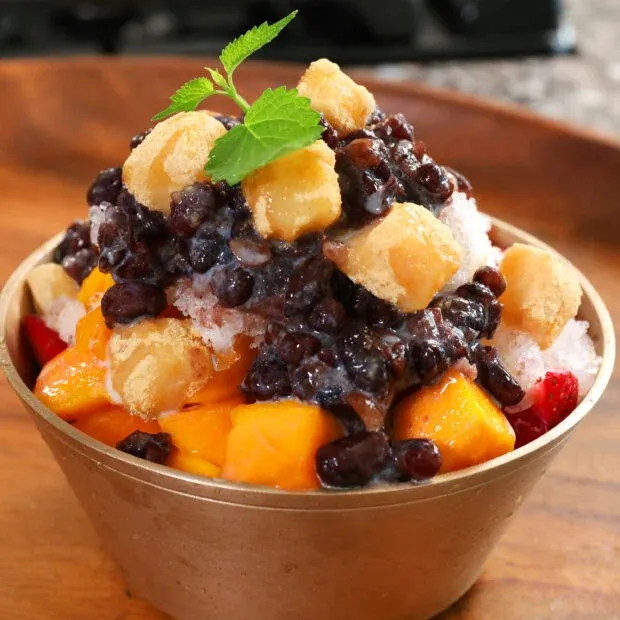
“No, it was dessert. Mine had mangoes, like I said, but Mrs. Park, who was with me, had one with red beans. Beans and ice cream—what a combination! Who would have imagined? I tried hers and it was really good.”
“Oh,” Jenny cried, clapping her hands together. “Beengsoo. Maybe you have p-a-h-t-b-e-e-n-g-s-o-o.”
“Isn’t that what I said?” Lucille asked, frowning.
As soon as she heard the words ice and beans Jenny knew what Lucille was talking about. Lucille’s pronunciation put her off. Jenny had plenty of similar experiences in English. She would say a word and repeat it over and over again, but the person she was talking to wouldn’t have any idea what she was saying. Then finally, when she got them to understand, usually by adding more words and supplying some context, they would laugh and say, oh you mean so and so. Then they would say the word exactly the way she thought she’d said it.
It was easy to hear words the wrong way. It happened to Jenny all the time, especially with songs. Even when she found out later what the real words were, she would often continue to hear it in the mistaken way she originally heard it. Once she told her older son, a teenager at the time, that she heard a song on the radio about a Korean girl. He asked what song, and she sang to him, “Honey, honey, Kim MiSeon.” He broke out laughing and said the line was, “Honey, honey, gimme some.” It became a family joke, which embarrassed her and made her feel stupid, but every time she heard the song, she couldn’t shake the notion that the singer was professing his love for a girl named Kim MiSeon. It made more sense than “gimme some” which didn’t mean anything to her at all.
“Very famous food,” Jenny said, glossing over the pronunciation issue. She wasn’t going to criticize another person’s pronunciation. “From Chosun Dynasty, long time ago, Korea people use to eat that.”
She thought back to her childhood and what a rare treat patbingsu was on a hot summer day. Ice itself was a luxury, and wasn’t usually available. Who had a refrigerator or even electricity in those days? But occasionally someone carted a block of ice into town and her mother would scrounge a piece of it and scrape it into a bowl. She added sweet red bean paste and pieces of glutinous rice cake called tteok. When Jenny was lucky enough to get such a treat, the ice-cold sweetness melted in her mouth and made her feel like she was in heaven.
Jenny was surprised that a simple treat like that had made an impression on Lucille, who was very sophisticated in her tastes and accustomed to sumptuous desserts. At Lucille’s house, Jenny sampled chocolate éclairs, almond truffle tarts, and many-layered tiramisu that were almost too rich to eat. There were even extravagant productions like crème brûlée and baked Alaska that were set aflame before they were served. How could a simple shaved ice dessert impress a woman used to such wonders? Jenny didn’t know, but felt proud that a simple dessert from her native country impressed her.
Jenny couldn’t get over the fact that Korean food was becoming specialty fare in America. She used to be ashamed if the odor of kimchi or doenjang, a fermented soybean paste—comfort foods she ate in private—lingered in the kitchen. For her, eating those smelly concoctions was a secret vice that she did her best to conceal from the outside world, and even her own family. But now kimchi had become an obsession with American foodies. It was everywhere. In hot dogs, burritos and tacos, on hamburgers, pizza and grilled cheese sandwiches. You could buy containers of it at the local supermarket, and people paid high prices for it, even though, it wasn’t, in her opinion, nearly as good as her own. What was once regarded as a nasty food from an impoverished country was now a gourmet food. Food wasn’t the only sought-after Korean commodity—television dramas, pop music and cosmetics were also gaining popularity. What was scorned was becoming valued. Like her mother used to say, “The ugly caterpillar turns into a gorgeous butterfly.”
Food now played a large part in Jenny’s life, much more so than when her husband was alive. How funny that she was spending more time in the kitchen now than when she had four mouths to feed. It wasn’t because she was eating more or because she’d been lax about feeding her family. The truth was that her husband and children didn’t care for Korean food, and the American style meals they preferred didn’t take much time to prepare. Throw some macaroni into a pot to boil, heat up some sauce, and it was ready in half an hour. It took no time at all to fry a steak or bake a meatloaf. But a good Korean meal took all day to prepare. She was lucky that her family didn’t want Korean food. It would have been a lot of work.
When her husband and younger son died in a car crash, friends and neighbors came by with bouquets of flowers and platters of food. After she’d recovered sufficiently to perform such duties, she started inviting those good people to her house to thank them for their kindness, and prepared traditional Korean dishes for them. It was what she knew how to do. She felt more confident serving them gimbap—rice and various other ingredients wrapped in seaweed, and mandu—a kind of dumpling, which she prepared expertly, than something like lasagna, which, she was sure, wouldn’t measure up to their standards. Everyone willing to try new foods liked what she made. In fact, it knocked their socks off. Korean cuisine was just starting to become popular then. Some of the more savvy folks were already familiar with kimchi and bulgogi, but the meals they had at Jenny’s were something new. Her reputation as a cook spread, and food lovers flocked to her house. Preparing food was good therapy for her after her loss, and a way to make friends.
Food was her salvation. Had it not been for food, she might have stayed home and become a recluse, but people stopped by to ask for recipes and watch her cook, hired her to prepare meals for them, dragged her to Asian restaurants and groceries for her opinions and advice. They invited her to their houses to show off their own cooking skills. Never before had she been so popular, so much in demand. For the first time, she had an area of expertise that she was respected for. Her self-esteem grew, and she became more comfortable around people. At first she was shy about speaking because she was ashamed of her English, but in time she cared less about making mistakes. People were more interested in what she had to say than in how she said it, and she gained confidence in her ability to communicate. In her new existence, she became friends with people of different ages and backgrounds, and for the first time, she felt like she fit in.
After Lucille’s departure, instead of turning on the TV as she might have done at that hour, she went to the kitchen, rinsed some adzuki beans and cooked them down, making the kind of sweet bean paste she used for danpatbbang, which Lucille insisted on calling called Korean jelly donuts. After the beans cooled, she crushed ice cubes in a food processor the way her friends had shown her to do to make margaritas and daiquiris, dumped it into a bowl and then spooned some bean paste on top. She had some tteok in the fridge, so she cut a small chunk and chopped it into little pieces. After sprinkling them on top, she carried the bowl to a straw mat in the living room and sat down. Then she closed her eyes and brought a spoonful to her lips. The patbingsu was for her what the madeleine was for Proust. It brought the past back not as a memory but as something alive. Just a taste of it awakened sensations she hadn’t experienced in over fifty years.
She was once again in the little hovel that was her home. Her father had died the year she was born, and her mother did the best she could to provide for the two of them in a country ravaged by war and mired in poverty. Despite the dire circumstances, her mother had somehow managed to make a special treat for her. As she sat in her own comfortable living room with the bowl of patbingsu on her lap, she lived over again that precious, fleeting moment that felt like heaven.
The last time she she tasted patbingsu was shortly before her mother died, finally worn out by the daily struggle. After that, life for Jenny, or, as she was known then, Jin-hee, became almost unbearable. She was sent off to an orphanage where she knew only drudgery and abuse. Day after day, week after week, year after year, she lived through a nightmare that she believed would never end. But when she was eighteen years old, something extraordinary occurred. On a cold December day, when she was peddling chestnuts in the street, an occupation which didn’t provide much money but kept her hands warm as she roasted the brown pods on a charcoal grill, an American soldier stopped and bought a handful. She’d never met a foreigner before, and it was a strange experience for her. He didn’t know what to do with the chestnuts and she had to show him how to peel and eat them. His clumsiness made her laugh and she placed her palm in front of her face in order not to appear rude.
She knew only a few words of English and he knew even less Korean, but they managed to communicate. The next day he returned and bought more chestnuts from her. He was there again the following day and almost every day afterwards for weeks to come. She’d never met anyone who liked chestnuts so much, and was very surprised to learn, years later, after they were married, that he didn’t care for chestnuts at all. Like a prince from a fairy tale, Eric had arrived out of nowhere and plucked her from a life of adversity. Just over a year after she handed him those first chestnuts, she was on an airplane with him, leaving behind forever her miserable existence, heading for a magical land full of wonder and happiness. America, the land of opportunity where she would start her life again. Everything that came before could be shaken off like a bad dream.
When she arrived in her adopted country, she was amazed at its vastness, its beauty, its variety. It was everything she dreamed it would be, at least in the beginning. In the great new land she had come to, she no longer had to endure the kinds of hardships she suffered in her native country. But there were other hardships of a different kind, that she had to cope with. She had a comfortable house, modern appliances, even a car, and most importantly a husband who doted on her. It should have been perfect, but somehow it wasn’t. Language was a problem. She’d learned enough English to get by, but not enough to have real conversations, or to express herself on anything but the most basic level. Sometimes, when she spoke, people laughed, and she didn’t know why. Learning English felt like climbing a mountain that went higher and higher with no end in sight. She would never get to the top of it.
Language wasn’t the only problem. She felt like she’d been plopped down among a different species of being. She wasn’t like them and didn’t belong. They looked at her in a strange way and sometimes said rude things for no reason. Even when people were friendly, it didn’t always feel comfortable. She was often treated like a “China doll” that wasn’t quite real. Eric was her interface to the world, her translator and buffer. That made life easier, but it also retarded her English progress and made her feel as dependent as a child—and it was a childhood she’d never grow out of. Sometimes it seemed that her old life in Korea with all its misery and hardships was preferable to her comfortable life in the US.
When she left Korea, she wanted nothing more to do with it, to expunge it from her existence, and erase every trace of it from her being. How peculiar it was then, when after just a few months in the promised land, she felt a craving, a gnawing in the pit of her stomach, for something that wasn’t satisfied by the food she ate. Never had so much food been available to her—all kinds of meat, fruit and vegetables. In a month she consumed more meat than she would have in a year or more in Korea, yet she felt hungry. She added rice to her diet and it helped, but it wasn’t enough. There were other tastes she longed for—the sharp, biting flavor of good kimchi, the rich, satisfying nuttiness of a steaming bowl of doenjang jjigae. When she placed those dishes on the dinner table, her husband held his nose, so she began preparing and consuming them when he wasn’t home and cleaning up all traces of their existence. He didn’t care what she ate in private as long as he didn’t have to see or smell the food she made. So began her secret culinary life.
In time life got better. The birth of her children gave meaning and purpose to her life and kept her occupied. The discomfort of her first years in the US diminished, and although thorough mastery of English remained elusive, she was fluent enough. She was and would remain an alien in a foreign country, but her condition wasn’t so different, she thought, from other outsiders, many of whom were American-born. People with darker skin, she noticed, were treated like her, sometimes with hostility, often with apprehension, tolerated at best. She didn’t have many friends, only a few casual acquaintances with whom she went shopping or to an occasional movie. She wasn’t unhappy, at least no more unhappy than anyone else. That was how the years slipped by, until the accident. That changed everything. Where the fullness of her life had been, there was now a gaping void. Her older son, thankfully, was alive and well, but he was at college far away. He came back home for a few weeks after the accident, but then he was gone, and made only occasional, short visits. She was alone in the world again, just as she had been after her mother died.
When she lifted the spoon from the bowl to her lips, her life in America evaporated. The patbingsu brought her back to a time in her life that she had all but forgotten, those days of her early childhood, before the orphanage, when her mother was alive, when there was someone in the world who loved her with her entire soul. Life was hard. Often there was no food to eat and no means of heating their little home through the bitter cold Korean winter. But still, she’d felt real happiness. The days at the orphanage had erased her good memories and focused her mind on bare survival. Now those early memories, reborn, flooded over her, and she wept. She wept for the losses she suffered and in gratitude for what she’d had. Her hot tears fell on the flavored ice, adding another dimension of complexity to its taste.
That night she slept well. Her dreams weren’t overshadowed, as they often were, by ominous portents and unknown dreads. When she awoke she thought of the patbingsu. She was still puzzled. For her, that food held a world of meaning. It transported her to another place and time that she had forgotten and lost sight of. But why was Lucille so crazy about the patbingsu she had at the restaurant? It was just flavored ice. It was a mystery and Jenny aimed to get to the bottom of it. She dialed Francine’s number. Francine was her closest friend. She was a regular person, not a food fanatic like Lucille. She was also about Jenny’s age and had lots of time on her hands.
“Francie?”
“Jenny, I was just going to call you.”
“What you doing today?
“Now?”
“No, afternoon.”
“This afternoon? The usual—nothing. Why? What’s up?”
“You come with me? New restaurant I want to go.”
“Count me in. What time?”
A few hours later the ladies walked through the doors of Choi’s Chic-Dang.
“I know what chic means,” Francine said, “but why Dang? I hope we don’t end up saying, ‘Dang it, we shouldn’t have eaten there’.”
Jenny laughed and said, “Shikdang mean restaurant in Korean. I don’t know why they spell c-h, not s-h. That not right. Maybe they have chicken food here,” she conjectured.
This time it was Francine’s turn to laugh. “No, chic is a French word. It means ‘fashionable’, ‘stylish’, ‘elegant’, you know, ‘trendy’, ‘la-di-dah’.” Francine, a retired middle school teacher, loved to dispense information.
“Oh, I know,” Jenny said, smacking her forehead with her palm. She had heard the word many times but thought it was spelled s-h-e-e-k or something like that. English spelling was much more confusing than Korean hangul.
“Anyhow,” Francine said, “clever name.” Jenny thought so too. It was an interesting fusion of Western and Asian. But she worried that the food would be a fusion, too, and that prospect didn’t please her.
They picked up their menus and studied them. After a few minutes Francine plopped hers down and said, “You decide for me. I have no idea what to get.”
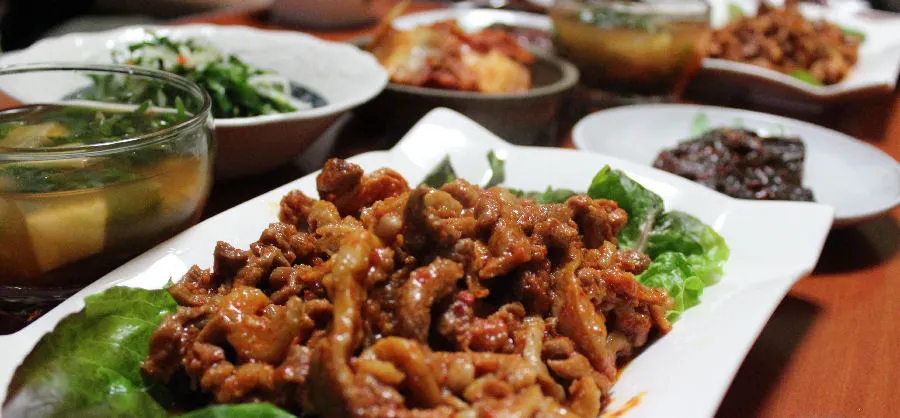
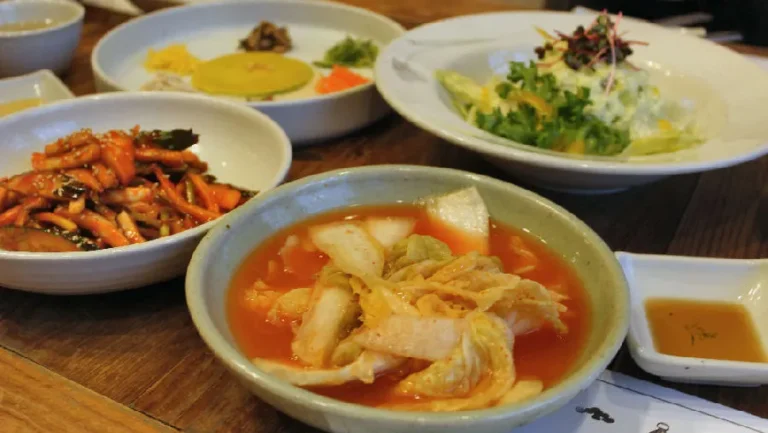
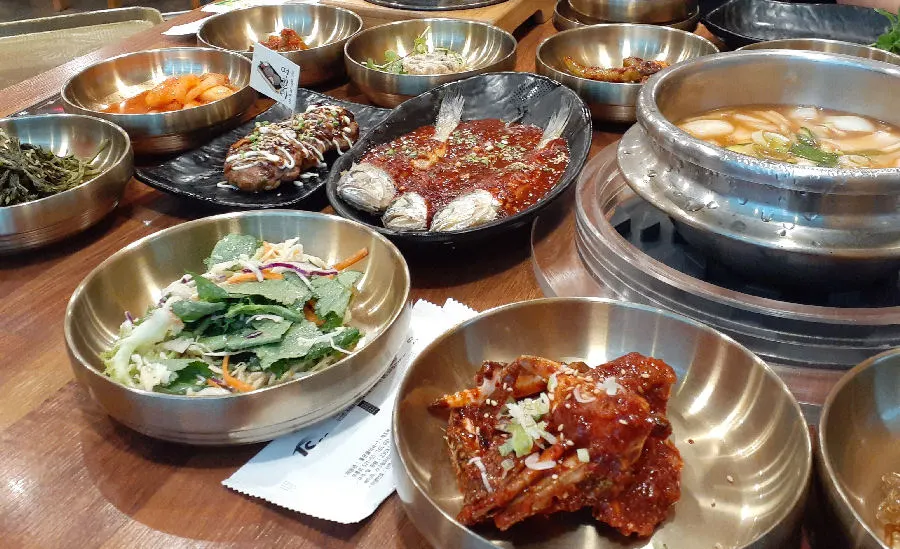
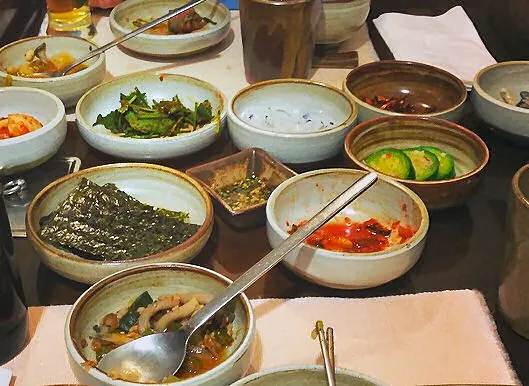
In short order, the table was crowded with a multitude of small dishes containing marinated bean sprouts, steamed eggplant, braised tofu, dried squid, spicy cucumber salad, glazed lotus root, seasoned spinach, stir-fried anchovies, sweet potato noodles, beef dumplings and several kinds of kimchi.
“Oh, my,” Francine said. “You ordered too much food.”
“Not order,” Jenny told her friend. “That banchan, Korean side dish. Every meal has. Our food coming soon.” Francine shook her head in amazement, but sampled every dish while Jenny explained what they were.
The sundubu jjigae Jenny ordered was decent enough, but she thought her own was maybe just a little better, a little closer to what it was supposed to taste like. Francine thoroughly enjoyed her entrée and when she finished she looked up at her friend and said, “So tell me, Jenny, what did I just eat?”
“Your food called bibimbap.”
“Bibimbap? I love that name! So alliterative. I’m going to remember that.”
A catchy name adds to a food’s panache, Jenny knew. She thought of shishkebab, chimichanga and jambalaya and wondered if they didn’t owe at least some of their popularity to their names, which rolled off your tongue and made you smile. Maybe someday bibimbap would catch on in America, too.
“Anything else?” the waitress asked as she cleared away the dishes.
Francine shook her head, but Jenny said, “Yes, we like some patbingsu.”
“Popping Sue?” said the American girl, exactly the same way Lucille pronounced it. “Of course. We have coffee, chocolate, melon, blueberry, strawberry, mango cheese and red bean.”
“So many choice,” Jenny marveled. “For me mango cheese. How about you, Francie?”
“I’ll just have coffee,” Francine said, thinking she was ordering a cup of java.
After a while the waitress returned carrying a tray with two heaping bowls. “Oh, my,” Francine shrieked. “What’s all this?”
“My treat,” Jenny said smiling. “Special Korean dessert,” she added, thinking as she said it that it didn’t look like any Korean dessert she’d ever had. The icy mounds were studded with fruit, nuts and pieces of cake. The women lifted their spoons at the same time and dug in.
“Oh my, oh my, oh my,” Francine gushed. “This is s-o-o-o good.”
Jenny understood what Lucille had been raving about. The dessert melted in her mouth leaving behind a trace of subtle flavors. Instead of shaved ice, the patbingsu seemed to be composed of a light, delicate snow, like manna from heaven.
“Amazing,” was Francine’s verdict. “It’s so light.”
Jenny agreed. The two ladies were busily dipping their spoons into each other’s bowls when an Asian woman in an apron stepped in front of their table and asked if they had enjoyed their meal. She introduced herself as Mrs. Choi, the owner and cook. Speaking in Korean, Jenny expressed her surprise to Mrs. Choi about the patbingsu and told her how different it was from the simple red bean dessert she’d had as a child. Mrs. Choi explained how the snow was made from frozen condensed milk rather than regular ice cubes, and talked about how food and everything else was changing in Korea. When she heard that Jenny hadn’t been back to Korea since she left in the late 1960’s, she told her that she had to go back and see the big changes that had taken place. “You have to go,” she urged her. “You won’t believe it. After you see Seoul, you will think that Korea is more modern and developed than America.”
On the way home, Jenny couldn’t stop thinking about the patbingsu. The mango wasn’t such a bad addition. Sweet red bean paste was, after all, like a fruit jam, so what was the harm in substituting other kinds of fruit, as long as the end result was good? Mrs. Choi transformed a simple traditional dish into something fresh and exciting. She, too, might be able to make dishes even better than the originals by using techniques, equipment and ingredients not available before. Why limit herself to re-creating what had already been done? But she was a traditional cook, dedicated to making her dishes exactly as they’d always been made. If she turned her back on that, what was she? It would be like admitting that the way she’d done things all her life was wrong, and that would be too much for her.
When she went to bed that night, Mrs. Choi’s words about how much Korea had changed were still swirling around her head, and she had the crazy idea of visiting her native country. Such a notion had never occurred to her before. She’d spent much of her life trying to be a real American and ridding herself of her Korean-ness. Did it make sense to visit the place that was the source of so much of her trouble? Besides, she had no friends or relatives there, and now she was American, an American citizen. But, of course, she was Korean, too, and she always would be. She had to go and see for herself. If an entire country could change, surely she could change. She didn’t have to keep being who she’d always been, and continue doing things the way she always had. With that thought, she felt she had cast off a weighty garment that she no longer needed, and she closed her eyes and drifted off to sleep.
August 2017