

Non-Fiction
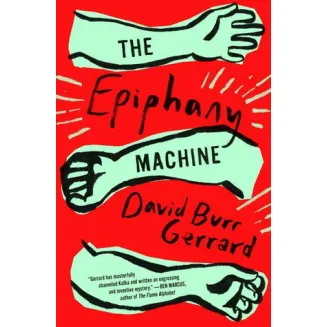
The Epiphany Machine
by David Burr Gerrard
The epiphany machine is described as a device that looks like an antique sewing machine or the jawbone of an extinct animal (one of the many contradictions about the apparatus fueling the ambiguity and humor driving the novel) that tattoos the arms of users with a phrase that reveals their quintessential nature—or is it their most serious failing, or are they the same thing? It’s a divine or diabolical creation, or perhaps just the prop of a clever charlatan, with conflicting origin myths. The device is a brilliant concept for a novel, but that’s just the starting point. It’s a wonderfully executed novel that will make you laugh out loud and then somberly reflect on a world that always seems to be changing for the worse. It is drenched in irony and wonderful plot twists, with characters who feel real. This is a book which leaves the reader with a lot to think about.
On one level, it’s a romp. The novel is so entertaining and so much fun that the craft underlying it can go unnoticed. Gerrard has a knack for conveying ideas in deceptively simple ways. The story begins with these words: “The epiphany machine will not discover anything about you that you do not, in some way, already know.” We have no idea, at this point, of what the epiphany machine is—but this is an elegant description of what an epiphany is, whether triggered by a psychotropic drug, a religious experience, or the eponymous machine of the novel. An epiphany isn’t a discovery of something new, but a realization about something that has been staring you in the face all along. Narrated by the main character, Venter Lowood, the story is interspersed with extracts from various pieces of writing and testimonials transcribed by Venter, that present many different voices and viewpoints. The nested stories presented in this way not only create great narrative opportunities but introduce characters who re-emerge, as in a Dickens novel, to play important roles in the chronicle. The dialogues, which are often hilarious, aren’t just for show, but develop characters that become very real and believable.
The author deftly integrates the testimonials Venter collects into the narrative and blends humor with more profound thought. “If anyone else had gotten the epiphany tattoo that I got,” begins one testimonial, “it would have ruined Adam Lyons [the machine’s curator]. Maybe the fact that it went to me . . . was a stroke of luck for him. Or maybe I got it because it was actually meant for me.” That last sentence, frames a basic question—are the tattoos as random as the message in a fortune cookie, as meaningless as a newspaper horoscope, or do they tell an essential truth about a person? The problem that brings this client to Adam Lyons is his imminent marriage to a non-Jewish woman, in defiance of his mother’s wishes. The quandary makes him sick enough to consult a physician who diagnoses him with either a parasite or wedding jitters(!) and opines, “Of course, a wife sometimes is a parasite,” before rolling up his own sleeve and showing his tattoo, which says CAN TOLERATE WIFE, and explaining how that tattoo saved his own marriage. “When she yells at me,” he says, “. . . for putting forks tines-up in the drying rack rather than tines-down the way she likes, I think: I can tolerate this. So I do.”
In this light and amusing way, Gerrard poses a significant question about the tattoos—do they state what is true or do they cause something to become true? Before administering the tattoo, Lyons advises his client, “You’ve already given God your foreskin, you don’t owe him the rest of your dick.” The vacillating bridegroom laughs and says that it wasn’t God he was concerned about but his mother. “So,” Lyons asks, “you owe your mother the rest of your dick?” The tattoo that the man eventually receives, to Lyon’s apparent chagrin, is DIRTY JEW. Rather than being upset, the client is pleased and provides his own interpretation: “A neutral observer would probably have thought I had been the victim of an anti-Semitic hate crime. But you have to remember that the only person who can really understand an epiphany tattoo is the person who gets it. The machine was telling me that I dirtied my Jewish heritage and that I needed to clean up.” Here again Gerrard presents crucial information about the interpretation of tattoos in an entertainingly ironic way.
The epiphany inscribed on Venter Lowood’s arm, DEPENDENT ON THE OPINION OF OTHERS, deeply offends him. As an aspiring author, he values independence of thought, not appreciating that concern about the opinions of others is a quality necessary for living responsibly within a community of other human beings. Not caring about how others perceive you marks you as an outlaw, someone outside of the bounds of society. We’re all attracted to the independence of living free from restrictions from the outside, but such personal freedom is at odds with society and civilization, and Venter’s journey is one of coming to terms with that conflict, as well as accepting the very imperfect human being he is.
Some things that generally annoy me in a novel, such as the insertion of real people in a story of fiction, and writing about writers, Gerrard manages to accomplish in a way that is both clever and integral to the tale. In this novel, there isn’t just one author or would-be-author, but a slew of them. Pretty much every major character is, in some way a writer. And the non-fictional characters, the most prominent of which is John Lennon, are not there because the author has taken a shortcut to describe a character (the way a lazy author might convey a character’s prodigious appetite for alcohol by inventing a scene in which he drinks Charles Bukowski under the table), but to provide a connection between the fictional world of the epiphany machine and the actual world we live in. The result is that what seems a far-fetched fiction feels, by the end of the book, quite realistic, if not the world in which we are now actually living.
November, 2018