

Non-Fiction
Superman
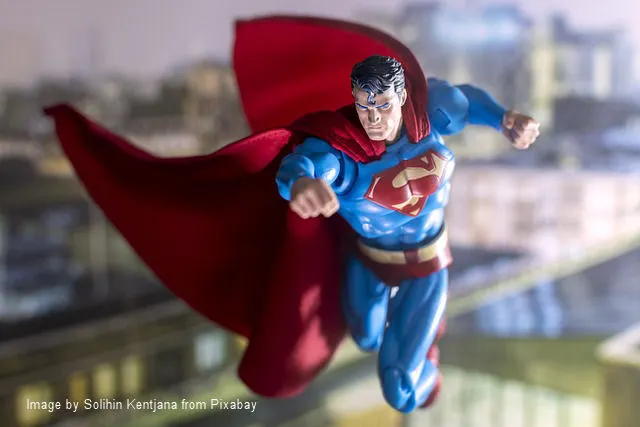
We all have multiple identities, because race, nationality, ethnicity, age, gender and a host of other factors are different facets of our beings. Reflecting on dual identities gave rise to thoughts about secret identities, which led, in turn, to thinking about Superman. Back in the 1930s, a couple of Jewish boys in Cleveland created the Superman comic. I don’t know if their idea for a super-powerful comic book hero had anything to do with the concept of the Übermensch, that would serve as justification for the extermination of those deemed inferior, or if feelings of powerlessness gave rise to imagining a super-being who champions the weak and oppressed. With God being dead, there was, after all, a vacancy to be filled.
I’m not up on my superheroes, but I know Superman wasn’t the first character with exceptional abilities, and certainly not the last, to have a secret identity. The Phantom and the Lone Ranger and Zorro preceded him, and even Tarzan can be considered an antecedent. Would it be sacrilegious to add Jesus to the list? But let’s get back to Superman. I’ve always had less trouble accepting the idea that Superman could fly, withstand the force of a speeding bullet and “leap tall buildings at a single bound” than the notion that he could change costumes in the wink of an eye and dispose of Clark Kent’s bulky suit and retrieve it again after his superhero duties were executed. Suspension of disbelief goes only so far. But even more of a head-scratcher is why he needed that secret identity of Clark Kent in the first place. Why couldn’t he be a full-time Superman? Weren’t there enough crimes and disasters in Metropolis to keep him busy around the clock?
For regular folk, a secret identity is often an aspect of the self that one is ashamed of, or fearful of revealing lest it lead to unpleasant consequences. Previous confinement in a federal prison for committing a heinous crime exemplifies the former, and hiding one’s Jewish heritage in WWII Europe exemplifies the latter. (In a karmic reversal, the Nazis of that era soon found themselves living in a world in which they were the ones trying to conceal their identity, and, if we’re lucky, the same will be true for their ideological descendants today who delight in terrorizing the powerless.) Superman and his superhero cohorts, however, are neither ashamed of their super powers nor out to protect themselves. So why resort to sharing their existence with Clark Kent, Bruce Wayne, Peter Parker, etc.? My guess is that Clark, Bruce and Peter are their dominant identities, and that their super-powered alter egos are secondary. They are humans who, despite their superhero gig, need to live among other humans, which they can’t do in their superhero guise.
In any case, the difference between Superman’s (or should we say Clark Kent’s) secret identity and that of the man on the street hiding something disreputable or dangerous is clear. Celebrities might appreciate Clark’s situation because they too are known for a specific attribute, their athleticism or artistry, for example, and not for who they know themselves as. It’s understandable that someone like Bob Dylan, who strove so hard to gain the limelight seems to have put as an equal amount of effort into trying to flee it. Clark Kent would no doubt feel the same way if he were forced to be Superman all the time, regardless of how he was dressed or what was going on in his personal life. Nobody wants their primary identity to be subsumed by their secondary identity.
To some extent, our multiple identities are in conflict within us. The surgeon who removes her scrubs, drives home and resumes her identity of mother and wife has a lot of internal negotiating to do, just as we all do, getting our various roles to mesh with one another. The difficulty is intensified when outsiders try to decide for us who we essentially are. An African American electrical engineer, who is a husband and father, a volunteer baseball coach and amateur musician and photographer is understandably perturbed when he is viewed and categorized by outsiders as “Black man.” It seems that the inability or refusal to understand the concept of multiple identities is at the root of many of our societal problems. For someone who happens to be gay or trans, a particular aspect of their identity has, in these times, emerged as the most salient aspect of that person, instead of one of many attributes.
Stripping Superman of his Clark Kent identity is tantamount to stripping him of his humanity, because without living as a regular person among other people, he becomes simply a freak. Stripping people of their humanity appears to be the point of the pressures now being exerted on individuals whose wonderful and complex identities are reduced to one-dimensional and false characterizations of who they are, and it will take more than Superman to get us out of the mess we’re in because of it.
April, 2025