

Non-Fiction
Babel-ing
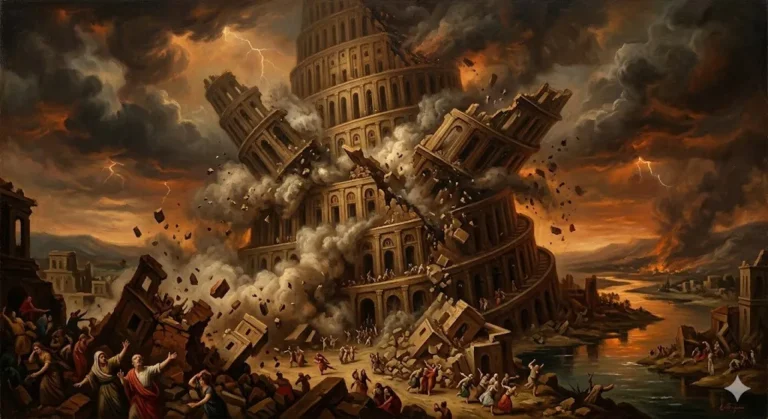
Watching footage of the rubble left in the wake of bombings of Gaza, Beirut and Tehhran reminds me of the story of Babel. In that fiasco, the efforts of people trying to build a place to live together were thwarted by the loss of the ability to communicate with one another. It’s a functional myth explaining the origin of different languages, tribes and ethnic groups, and also a reminder of the futility of trying to build a society that will thrive and endure, unless there is cooperation, communication and mutual understanding. This is how the Bible tells the story:
Now the whole world had one language and a common speech. As people moved eastward, they found a plain in Shinar and settled there. They said to each other, “Come, let’s make bricks and bake them thoroughly.” They used brick instead of stone, and tar for mortar. Then they said, “Come, let us build ourselves a city, with a tower that reaches to the heavens, so that we may make a name for ourselves; otherwise we will be scattered over the face of the whole earth.” But the Lord came down to see the city and the tower the people were building. The Lord said, “If as one people speaking the same language they have begun to do this, then nothing they plan to do will be impossible for them. Come, let us go down and confuse their language so they will not understand each other.” So the Lord scattered them from there over all the earth, and they stopped building the city. That is why it was called Babel—because there the Lord confused the language of the whole world. From there the Lord scattered them over the face of the whole earth. Genesis 11, New International Version (NIV).
That’s the whole of it, less than 200 words, shoehorned between the story of Noah and the enumeration of generations leading up to the saga of Abram, which is the start of a more continuous narrative with a steady story-line. I’ve wondered how this tale, unconnected to the text around it, ended up in that particular place, and decided that the writer’s mind, jogged by the story of the flood, inserted another tale of destruction occasioned by God’s wrath, just as earlier on, he presented side by side, two divergent creation tales of man and woman. [“So God created mankind in his own image… male and female he created them” (Genesis 1:27) and then man is created first and later, woman, from his rib (Genesis 2:4–25).] Moses is credited with writing the first five books of the Bible (the Torah or Pentateuch) and I believe he did, despite the skepticism of scholars and historians who insist it was written by numerous people over a long span of time.
Originally, I was with the doubters, convinced that Moses wouldn’t have had time for such a writing assignment, busy as he was with such activities as launching the ten plagues, splitting the Red Sea, leading the Israelites through the desert for forty years, hiking to the top of Mt. Sinai for an executive conference with God only to return to see the people he worked so hard for worshiping a golden calf. How would he have had the time? But then I considered. If Moses was frustrated with his recalcitrant followers, imagine how he must have felt when God informed him, after all his labor and travails, that while the fractious crowd he’d been herding would enter the Promised Land, he himself would not be permitted to set foot in it. Moses, I imagine, like many another bitter employee, took to writing to vent his spleen. It wasn’t all original stuff. He was the Hebrew Homer, blending things he knew of first-hand with stories and legends he’d heard. Moses knew how to spin a good yarn, and he certainly knew how to turn a phrase, but transitions weren’t his strong point, and so he tacked on the Babel myth without benefit of a smooth segue.
Writing gave Moses an outlet for his grievances, and in the tale of Babel as well as many other stories, he made God the heavy. Here were people literally being constructive and trying to build a place where they could live together harmoniously, and not be “scattered over the face of the whole earth,” so what does He go and do? He barges in, on the pretense that they were a threat to Him, turns everything to chaos and scatters them over the face of the whole earth. In Sunday school, children are taught that the people of Babel were punished for their pride and arrogance, but I see little evidence in the story of hubris on the part of the builders of Babel. [In his superb translation/commentary of the Old Testament, Robert Alter notes that “The polemic thrust of the story is against urbanism and . . . technology,” rather than pride.] The only character lacking humility and appearing prideful, petty and capricious is God.
There are similarities between the tale of Babel and Operation Epic Folly: a huge power, claiming it is endangered by a much lesser power that has done nothing to provoke it and poses no reasonable threat, decides to annihilate it, and without conscience, remorse or mercy, relentlessly attacks, dispersing and displacing the populace, all the while maintaining that it was acting righteously and the other side was at fault. While in the Biblical story different languages and cultures were inflicted on the enemy to cause confusion resulting in the collapse and abandonment of the tower, in our current nightmare, difference in language, culture and ethnicity no doubt played a role in stirring up hatred for and fear of the enemy. The fact that Iranians don’t look or speak like Americans is reason enough for trying to wipe them off the face of the earth.
Even without considering the current war, the tale of Babel is an apt one for these times. Human ventures often begin cooperatively and deteriorate as individuals, driven by their own visions, expressed in their own language, fail to communicate and cooperate with one another, and end up destroying what has been created. As we witness the unraveling of the fabric of our society, and see the magnificent edifice of knowledge built over millennia on the verge of collapse, we seem unable to stop the destruction of ourselves and the earth that sustains us. Civilization, like the Tower of Babel, is in danger of toppling as racism, egotism and plain stupidity prevent us communicating and cooperating.
March, 2026