

Non-Fiction
What We Talk About When We Talk About Gaza
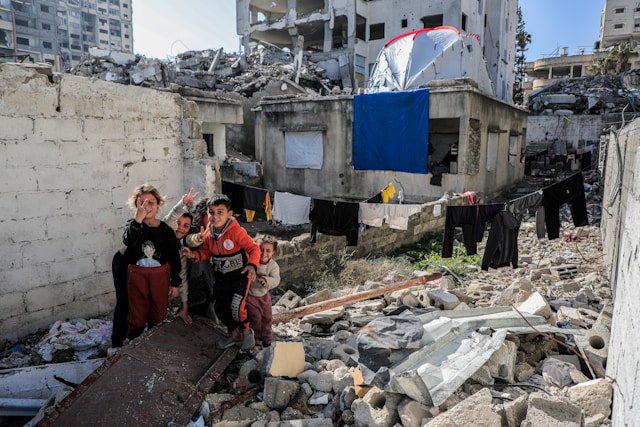
Some of the most disturbing images from the Israeli-Palestinian conflict I’ve seen are those of jubilant West Bank settlers with yarmulkas flapping on their heads and long payot dangling down their cheeks dancing and jumping up and down ecstatically as if celebrating the joyous holiday of Simchat Torah and performing a great mitzvah as they demolish truckloads of food aid bound for Gaza. Meanwhile, other images of starved infants and children, reminiscent of photos from Nazi concentration camps, sear our consciousness. Yes, I understand that those settlers must really believe that what they’re doing is right and righteous, in the same way Nazis must have been guided by passionate belief as they exterminated Jews. I don’t doubt the sincerity of either group of zealots. I am only appalled that adherence to an ideology would blind them so completely to the suffering of other human beings. Religious fervor linked to such devastating inhumanity is enough to turn anyone against a religion, a country, a people.
In an interview, the Jewish actor Mandy Patinkin said Netanyahu’s policies “are endangering not only the State of Israel, which I care deeply about and want to exist, but they are endangering the Jewish population all over the world.” The statement is telling. When we talk about what is happening in Gaza, we’re talking not only about a humanitarian crisis and the tragedy of the Palestinian people, but the repercussions of those events. I don’t doubt Patinkin’s genuine concern about the Palestinian people, and commend his activism and courage in speaking out. He is, however, also aware of how the barbarity of Netanyahu can personally impact him and his family, as it incites anger against all Jews and provides new justifications for antisemitism. In a sense, Patinkin is saying he is furious that his identity as a Jew, not a matter of choice but something imposed upon him, has been irredeemably tarnished by Israel’s actions in Gaza. It doesn’t just affect how others see him, but how he sees himself. It’s akin to having a family member revealed to be a mass murderer. How do you disown and disassociate from someone to whom you are closely connected? How can you say, “No, I’m not like that,” and convince others and yourself?
In a conversation with Peter Beinart, Jon Stewart has this to say about being criticized for his comments about what is happening in Gaza: “I feel like I’m watching something that is so self-evidently inhumane and horrific. And to be told that I have to shut up because I risk the Jewish state by speaking out? I would say the opposite. I think not—I think they’re putting the likelihood of a surviving Jewish state much more at risk with this type of action.” In their discussion, both men try to cope with the issue of part of their identity—the Jewish part—being at odds with how others want to define what it means to be Jewish. Although their ways of being Jewish differ, they are in complete agreement in how they see what’s happening in Gaza, and because of that, both are the targets of many Jews and a good number of non-Jews who condemn them as antisemitic. An antisemite used to mean someone who abused or persecuted Jews, but now means, according to US law, apparently, anyone who criticizes Netanyahu. In other words, it’s more or less the same way “patriotic American” used to mean someone who defended the Constitution, but now is redefined as someone loyal to D. J. Trump.
Ah, the complexities of identity. We try to forge identities for ourselves (are those identities we work so hard constructing forgeries?) that we are comfortable with, but have also been stamped with identities in the form of how we look, how we were raised, and who we are related to, that are indelibly part of us. A great deal of the animus among Jews these days, especially in regard to what’s happening in the Middle East, seems to stem from a battle to define Judaism—the Zionists claiming that whatever Israel does is right and just, and the diasporists taking the position that humanism and empathy are the true foundations of Jewishness. Yeah, pretty similar to the battle being waged over what it means to be an American and a patriot.
While I’m sure that how I framed these issues leaves little doubt about my own stance on them, I want to return to the original point I was trying to make. The discussions raging about Gaza, about who’s at fault and who’s to blame, are less about Gaza than about the identities of the people doing the arguing. The positions we take are meant to mark out who we are and reinforce the identity we are trying to establish. When we talk about Gaza—maybe when we talk about anything—it’s really ourselves we are talking about. As the horrific images of starving children testify, when we talk about Gaza, we are also talking about what it means to be a human being.
August, 2025