

Non-Fiction
End Times Fascism
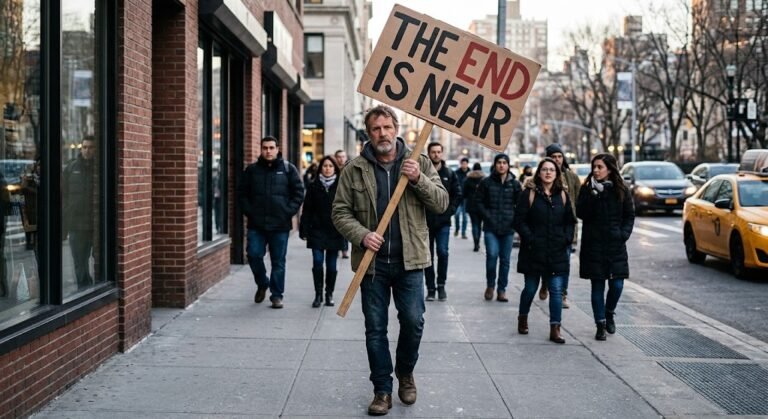
We aren’t headed towards fascism. It’s already here. It’s been two months since hundreds of people were rounded up in the most brutal way and shipped off to a hellish prison in El Salvador. College students have been detained for exercising their rights to free speech, and piece by piece, government agencies have been dismantled, institutions destroyed, and the principles on which they were based have been turned inside out. The catalog of abuses and injustices are too lengthy and disheartening to list. Things will undoubtedly get much worse, but they’re already very bad. Serious as the situation is, the depredations of the Trump regime aren’t the focus of a frightening and enlightening essay by Naomi Klein and Astra Taylor discussed in the interview linked above, but rather a wider and even scarier movement of which the destruction of our nation is only a part. This post isn’t about the essay (which I hope everyone will read) per se, but my thoughts and reactions to some of the points it makes, which I’ll introduce with a story.
“You see,” The old man continued, “occasionally we work together, we cooperate and produce something astonishing and beautiful. We can travel to the moon and beyond. Just think of it! But for the most part we work against each other because we all want to show that we’re smarter, stronger and better than our neighbors. We’re born egoists, trying to outdo everyone else in any way we can. As far as our egos are concerned, each one of us is the center of the universe and there is nothing else of consequence. Acknowledging the existence and equality of others is anathema to the ego, but necessary for society and civilization. That’s been the problem from the beginning. Our monstrous egos are what every religion and every society have tried to curb, and they pretty much rely on one simple principle.
You know what I’m talking about, don’t you, Johnnie?”
I wasn’t sure I did. Like so much of what the old fellow said, I didn’t know if he was talking about something concrete or abstract, specific or general, trivial or profound.
“Of course, you do,” he bellowed, like a teacher impatient with a student slow to grasp a concept. “It’s the Golden Rule. ‘Do unto others as you want them to do unto you’ or ‘Don’t do to others what you don’t want done to you’ or ‘Love your neighbor as yourself’ or even ‘All men are created equal.’ All iterations of the same thing, all reminders that we live among other human beings just like ourselves. Whatever the differences between us, we’re all equally human. The most gifted and brilliant among us, Einstein, Shakespeare, and Da Vinci, all great men, of course, but not a whit more human than the most wretched outcast. The outcasts are no less human than anyone else. Sure, some people are more gifted than others. Immeasurably so. But not more human. Do you see what I’m getting at, Johnnie?”
I let out a feeble “heehaw.”
“That’s right. Such a simple idea and it’s been around forever. They knew it in ancient Egypt, India and Persia. There’s a version in every country on every continent on earth. The earliest philosophers touted it as does every religion. It’s not just a religious precept but the core of every religion. That little idea is the germ of all morality, the very foundation of civilization. Once we recognize that other people are just like us, we have to concede that they should be treated just as we want to be treated. Maybe we can’t empathize directly with others but we can do it through ourselves. That’s the genius of the precept. We can use ourselves as a measuring stick for how to treat others. What happens if we don’t recognize the humanity of others? We exert our power and do terrible things to them because there is no connection between them and us. Our egos run riot. We enslave, torture and kill. We do to them the very things we don’t want to happen to ourselves.”
The old man was getting so worked up he was beginning to make me nervous. He had the look of an Old Testament prophet railing against sinners, an enraged Moses descending from Mt. Sinai with the tablets raised over his head, seeing his followers worshiping a false idol. I cowered before him.
“It’s very strange,” he said, in a much calmer voice, philosophically, sadly. “All those injunctions were for naught, it seems. You know where they went wrong, all the religious and legal codes? They added too much fluff to buttress and support the main principle, all those ‘thou shalt’ dos and don’ts. People get too preoccupied with the small stuff. They get absorbed in the ritual and trivia surrounding the main thesis and lose sight of the thesis itself. All that other stuff is window dressing, the wrapping paper around the gift.”
I found myself eagerly nodding my head and neighing in agreement. The man had an undeniable flair for oratory.
“That’s just how people are, easily distracted. They come up with a good idea and then fortify it with unnecessary formulations and amendments. They create symbols to represent the things they believe in – a cross, a crescent, a star – and end up worshiping the symbols and ignoring what they represent. They keep the chaff and discard the wheat. It’s a pity the Bible got sidetracked with sins against God instead of staying focused on sins against fellow men. God doesn’t need all that protection. He can take care of Himself, right?”
I nodded my head in assent. What he said made sense to me.
“It’s funny,” he went on, shaking his head in a way that showed he didn’t find much humor in it, “how people use religion to justify and defend the deplorable way they treat each other. They use it to overthrow the very end it was created for, getting people to treat each other decently. Religion ought to prevent war and other depredations, but what happens instead? People go and fight wars on behalf of religion. That fellow there,” he said pointing to a squirrel scurrying up a tree, “has no moral code. Humans are the only animals that have a moral code, or the need for one.”
As the passage above from my novel An Ass’s Tale (2019) suggests, empathy doesn’t come naturally to us self-absorbed human beings. But since human societies and civilization itself depends on cooperation, which is fostered through empathy, institutions concerned with the development and preservation of civilization have sought to promote empathy. Religion (through promulgation of the Golden Rule), government (articulated in the formulation “all men are created equal”), and philosophy (Plato regarded empathy as the highest form of human knowledge) all try to instill in us the idea that being respectful and considerate toward others and recognizing their humanity is the basis of morality and decency.
It’s such an elemental and universal principle, endorsed equally by reason, conscience, and law, that Elon Musk’s claim that “empathy is the fundamental weakness of western civilization,” referenced in the Klein-Taylor essay, is nothing less than shocking. It’s not just Musk being provocative. The video, (not the essay) cites the book Toxic Empathy: How Progressives Exploit Christian Compassion (4.3 on Goodreads 3,397 ratings). Why wage war against empathy and the Golden Rule? Well, atrocities against other humans beings, genocides and injustices, can’t be committed or tolerated by people imbued with a sense of empathy, and it’s hard to turn groups of people against each other if they view one another as equally human. So giving empathy a bad name is fundamental to the rest of the project, which entails not just the destruction of democracy and individual rights in our country, but a much larger goal—the destruction of world order, civilization, and even our planet and all its lifeforms. This is a death cult on steroids.
Like the wizard world overtaken by the evocatively named Death Eaters in the Harry Potter novels (who are obsessed with blood purity much as our current leaders are with racial purity), our world is now besieged by a death cult, but it’s the death of everyone else, not so much themselves, that they’re intent on. They’ve given up on this world and are ready for the anointed few, the new Chosen Ones, to move on to something else. Wealth and power have freed them from the privations of the masses. They are the masters of the world and not like the rest of us. You would think they’d enjoy their wealth and good fortune instead of using it to make the lives of others more tenuous and miserable. What’s behind their hateful, destructive project?
My best bet is that they’re petrified of dying. The thesis of Ernest Becker’s great book The Denial of Death is that human behavior is driven by fear of death. By distancing themselves from the common lot of mere mortals who have to work, sweat and suffer to scrape by, the super-rich see themselves as a special case, not subject to the laws of the universe. No wonder they dislike science, which informs them that they too will die and decompose. Empathy, the recognition they are like others, is anathema. They refuse to concede they are mortal and will, like everyone else, die. It’s not surprising that the prime goal and sole achievement of the current regime is making life harder for others. But, alas for Musk & co, even if they escape from earth and regulation, even if they create immortal AI avatars of themselves, even if they succeed in avoiding taxes, they will not avoid death. The question is what happens to the rest of us while they pursue their infantile, crazy dreams, and that’s what the Klein-Taylor essay is about.
May, 2025