

Non-Fiction
Edgar Degas and the Epstein Files
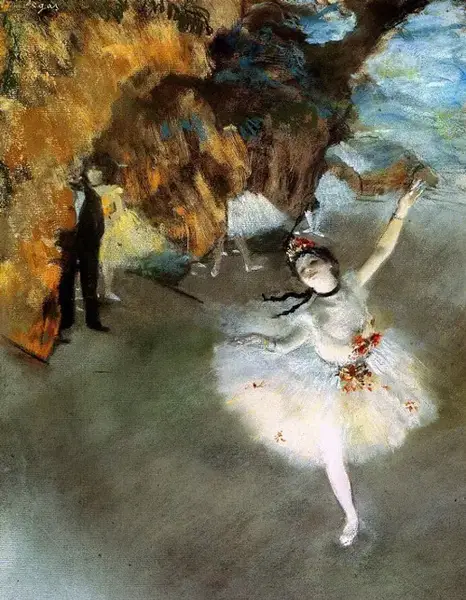
No, the man in the tuxedo lurking among the ballerinas is, of course, not Jeffrey Epstein, but after viewing the video below, you may see a connection. I never gave much thought to the gentlemen in the background of some of Degas’ ballet paintings, assuming they were producers or coaches or had some official function. After being enlightened by the video, however, I started seeing those shadowy figures in a different light. In fact, what they brought to mind were the kind of wealthy, privileged fellows who have license to roam around the dressing rooms of beauty pageants and leer at the half-dressed girls. You know the type.
Those gentlemen in Degas’ paintings of ballerinas were abonnés, wealthy subscribers to the ballet, who were invited into the studio to watch the young girls rehearse in exchange for their financial contributions. The girls, for the most part, had no objections to the old geezers ogling them, because each of them desperately desired a protector to ease her life of abject poverty. The ballet, in effect, functioned as a brothel for the well-to-do. In 19th century Paris, the ballet presented to young girls and their impoverished families a way out of the hopeless, destitute lives they were trapped in. By becoming one of the petits rats, as they were so endearingly called, the girls had an opportunity to attract a wealthy patron on the prowl for a mistress. Thinking of those young girls seeking a better life and getting lured into a life of prostitution brought to mind Jeffrey Epstein and Ghislaine Maxwell.
It’s hard not to be dazzled by the political intrigue surrounding the Epstein affair. It has more twists and turns than a John le Carré novel—his connections to the current president and other influential men; the suspicious circumstances of his death; the mysterious non-prosecution agreement that first let him off the hook; the conspiracy theories connecting him to the Mossad; and especially the unwillingness of the Department of Justice to release the trove of evidence connected to the case. Add to that the colorful life of the father of his accomplice, Ghislaine Maxwell. Robert Maxwell, born into a poor Jewish family mostly exterminated by the Nazis, became a decorated war hero in the British Army, served as a Member of Parliament, made a fortune in the publishing business, and later embezzled hundreds of millions of pounds from his companies’ pension funds before dying mysteriously by falling off his yacht (the Lady Ghislaine!). He was believed to have had links to the Mossad, MI6, and the KGB, and was afforded high honors at his funeral in Israel, attended by the president, prime minister and other officials. Rumors swirl that Robert introduced his daughter to Epstein and may have been the source of his son-in-law’s early wealth. Is it any wonder that the Epstein affair has captured our interest?
Fascinating as all that is, the real story story isn’t Epstein, Maxwell, or their sleazy clients, but the hundreds of young girls ensnared by them—and the socio-economic system behind it all. The story of the petits rats and Epsteins’s victims is one of exploitation by the haves of the have-nots. Some may object that Epstein’s victims were not destitute like Degas’ ballerinas, and bear some responsibility for what happened to them. But they were young girls, with little experience of the world, enticed by successful, respectable people from the highest echelons of society, as well as by a style of living orders of magnitude removed from their own. What made the depredations of the abonnés possible was the cloak of respectability provided by the prestigious Paris Opera, and what made Epstein’s crimes possible is a culture that elevates success above all else, and creates an elite class of wealthy, powerful people who are above the law and not bound by moral or ethical norms.
There is a sense in which the abonnés were also victims. I would be surprised if their sexual appetites alone led them to haunt the ballet studio and spend their time and money acquiring mistresses, and the same is true for Epstein and his ilk. They were doing, to some extent, what was expected of them in the positions they had attained. They were as entrapped in their roles as their victims were in theirs. It’s difficult to feel much sympathy for those responsible for so much of the suffering of others, but unless we attend to the underlying causes of injustice, we will not fix it, but only replace the current abusers of power with others, maybe formerly victims, who will torment a new generation of victims.
I don’t think it was Degas’ intention to expose or criticize the abonnés, although his depictions of them weren’t very flattering. I think he was only interested in faithfully representing the scenes he saw. That his paintings could spark a discussion about social mores a century and half later is a reminder that art is not only a vehicle for aesthetic pleasure and appreciation, but a form of communication of ideas, values, and insights that live beneath the surface of a work.
September, 2025