

Non-Fiction
Faking It

In an earlier post, I wrote about being duped by fake videos online and unintentionally promoting them by liking and re-posting them. I’m sorry to say that, despite those learning experiences, I’ve fallen for more fake postings (probably more than I realize!), and think it’s worthwhile to visit the topic again because of how ubiquitous the fakes have become and how insidious they can be.
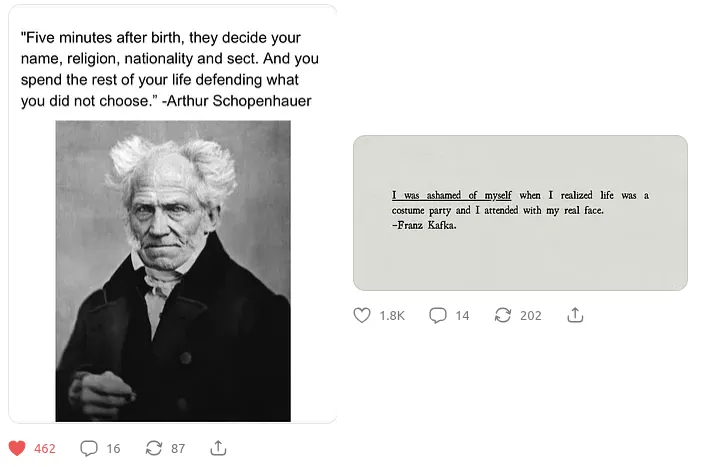
I saw the quotations above on Substack and thought them insightful and provocative. On trying to find where, precisely, they came from, I learned that both were widely attributed online to the authors indicated, but couldn’t be found anywhere in their works. Perhaps the quotations accurately reflect the sentiments of Schopenhauer and Kafka and were innocently presented as re-phrasings, or more likely, someone came up with the aphorisms and attached eminent names to give them more authority (and clicks). Incorrect attributions of quotes are common—Mark Twain and Albert Einstein probably didn’t make half the witty comments credited to them—and long predate the internet, although that technology spreads information, true or otherwise, so fast (note the number of likes and re-stacks those posts have). But this kind of misrepresentation is relatively innocuous, and the epigrams are worth sharing, regardless of who wrote them.
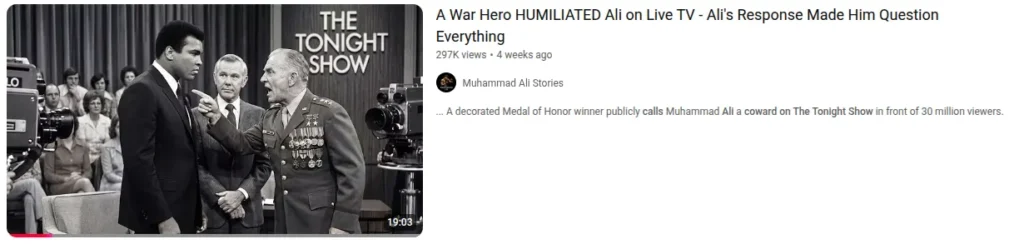
The next level of deceit, represented by the confrontation pictured above, is less innocent. (I didn’t want to embed this video and help it get more views, but here is a link.) The video begins as follows:
The cameras were rolling live when a Medal of Honor winner called Muhammad Ali a coward in front of 30 million viewers. What happened next in those tense 12 minutes would become the most watched moment in television history and transform both men’s lives forever.
It was curious that I had no recollection of an event presented as a significant piece of television history. The broadcast, according to the video, took place on March 15th, 1973, and everyone, even those without a TV set, would have heard about it. There were several other problems with the video. For one thing, it seemed strange that Carson or the network would risk such a confrontation. It was also peculiar that no audio or video from the show was included, only a narration of the events while a picture of Ali showed on the screen. Suspicious, I looked for information about the broadcast, and found no evidence that it ever took place.
It’s a feel-good video that burnishes the reputation of Ali (and the fictional colonel), not a malicious one inciting hate, and reminded me of the video I cited in my earlier post about a debate (that never took place) between Jasmine Crockett and Mike Huckabee. Even though these fictions dressed up as true occurrences don’t malign anyone, they aren’t harmless. They mislead, create false impressions, and blur the lines between what is real and what is made up. It’s like presenting a speculative novel as historical non-fiction, intentionally distorting reality. And misinformation can spread fast—in just a month, the Ali video got more than 300k views.
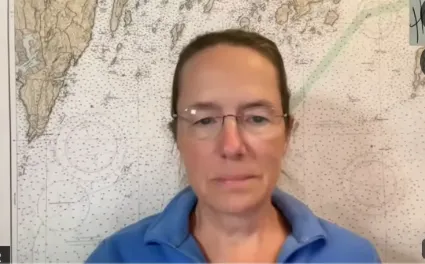
More disturbing yet was a video that I can’t provide a link to because (fortunately!) YouTube removed it. It featured Heather Cox Richardson (HCR) criticizing Alexandria Ocasio-Cortez (AOC) for presenting herself as someone other than who she really is, and depicting her as morally flawed. HCR is a commentator I respect, and I view her posts from time to time. I noted that this video was posted by some other entity, not HCR, but didn’t think much of it, having seen re-posts of that kind before. In the video, HCR stood in front of the usual map, looking and sounding as she always does. I was too wrapped up in what she was saying to think about the authenticity of the video. She sounded nuanced and thoughtful as usual, not outrageous, but I wasn’t happy about what she was saying. Who likes to hear negative things about someone they admire, and AOC is a public figure whose courage, intelligence, and integrity I find impressive, but I watched on, feeling a responsibility to hear something true, even if it’s unpleasant. That’s the attitude I have watching much of the news these days.
The complaint was that AOC used campaign funds, something like $50k, in an extravagant way, partying and living it up in Puerto Rico. The fake HCR granted that what AOC did wasn’t illegal, but it showed that she, like every other politician and celebrity, was a lover of luxury and extravagance, and not the caring woman of the people she pretends to be. I didn’t buy it. If there was extravagance, I assumed it reflected political necessities rather than personal preferences, but didn’t doubt the expenditures were made. It didn’t occur to me that the video wasn’t real. Instead, I questioned why HCR made so much of a relatively small infraction in the midst of the large-scale corruption and criminality besetting us. Did she feel morally compelled as a historian to report on AOC’s foibles?
Reporting what AOC had allegedly done would, I conceded, be the correct thing to do, but the piece disturbed me because it created a false equivalence and placed AOC on the same moral level as DJT. It was a long video and I didn’t watch all of it, but before I left, I checked out the comments to see if anyone else was as disgusted with HCR as I was. Among the various opinions, a number of people asserted the video was a deepfake. For me, the most convincing evidence provided was the fact that the image of HCR in the foreground was bit blurry while the map in the background was clear and sharp. I couldn’t believe how thoroughly I’d been taken in. The video was diabolically conceived, first inventing a misdeed by AOC, then using the trusted persona of HCR to undermine faith in AOC and in integrity generally.
Deepfakes are now (oxymoronically) part of our reality, and something we need to be on the lookout for, especially because, if we’re not careful, we can easily spread the infection. Everything online is suspect, and what we see and hear away from our screens is hardly exempt from suspicion. Deception isn’t something new or a product of technology. The desire and capacity to deceive is a human trait as old as Cain, and, in fact, not limited to humans, but widespread in the animal kingdom. According to a Scientific American article from 2019, “Many animals carry out disinformation campaigns . . . They mislead, cheat and lie in rampant acts of deception.” Considering our propensity to deceive one another and the tools technology provides to do so, it seems that we’re all going to have to keep on our toes. The trick is to also be able to trust, because survival and civilization depend on it.
December, 2025