

Non-Fiction
Religion, God and Morality
Long ago I noticed that there wasn’t much of a correlation between being religious and being a decent human being (if you can’t picture what I mean, just think of Speaker Mike Johnson), but I always attributed that to people rather than to religion. That is to say, I believed that the so-called religious people who acted in disappointing ways were not properly adhering to religious precepts. But that may be letting religion off easy. It turns out I’ve been confusing religion, God, and morality, and my error became clear to me by the merest chance as I watched footage of Don Lemon questioning a member of a congregation after a protest in his church. (I think it would have been better journalism had Lemon focused on drawing out the interviewee’s opinions instead of arguing, and that the protest might have been more effective had it been held outside the church in a less antagonistic way that aimed to persuade rather than show moral superiority. Nevertheless, the arrests were outrageous and repugnant, and all charges will, hopefully, be thrown out.)
The opinion expressed by the parishioner about ICE’s actions had nothing to do with morality, and everything to do with political orientation. By morality I mean the idea conveyed by the injunction to Do to others as you would have them do to you (Luke 6:31). By that standard, ICE’s actions are morally abhorrent, because who would want to be treated the way ICE treats people? Certainly not the ICE agents themselves, who cry abuse when merely yelled at or videotaped. If moral guidance is a function of religion, the church’s apparent support of what ICE is doing (reflected as much in the congregant’s response as its having an ICE official as a pastor), despite its immorality, is jarring.
Similarly disturbing is the support rabbis and their congregations have shown for Israel’s actions against Palestinians. Surely the starving and killing of an entire population can’t be considered moral, whatever definition of the word is used, and yet learned, pious rabbis not only refuse to condemn them, but attack anyone who does. Over a thousand rabbis signed an open letter opposing Zohran Mamdani’s run for mayor because he calls what’s happening in Gaza a genocide, even though that is the proper term according to genocide scholars, humanitarian organizations, and just about everyone around the world except die-hard Israel supporters. Angela Buchdahl, a prominent, mostly progressive rabbi who didn’t sign the letter, criticized Mamdani for his “false claims of genocide.” Is this not akin to Holocaust denial? These rabbis, like the church in Minneapolis, leave me bewildered about the relationship of religion and morality.
My reaction is one of dismay and incomprehension rather than condemnation. I just don’t understand how people can, under the flag of religion, not only condone, but champion immoral actions. If the role of religion isn’t to promote morality, what is it for? The man’s response to Lemon’s questions opened my eyes to what should have been obvious: religion is about tribalism, not morality. Religious institutions are essentially clubs, social enclaves where like-minded people gather. Like any other group, from a book club to a college fraternity, its primary function is to serve as a means for people to join together, because humans are, after all, social animals. It’s a place to find a place in our larger society, a place to belong and have our voice strengthened by being joined by other voices.
Sure, religious institutions are supposedly centered around devotion to God, but devotion can be manifested in many ways—by prayer, charitable works, or human sacrifice. There’s a lot of wiggle room for religion to do good and evil, and it’s a useful shield for very bad people and ideas to hide behind since it is not to be questioned or doubted. Just as the character of book clubs very, with some being devoted to romances, some to thrillers, some to classics and some to mysteries, churches also vary in their missions, some focusing on prayer, some on good works, some on prosperity. But the first concern of every club, regardless of its nature or stated purpose, is its own survival, which depends on attracting and keeping its members. With such practical considerations to contend with, it’s not surprising that less tangible issues such as morality can end up left on the wayside even in a club that labels itself as religious.
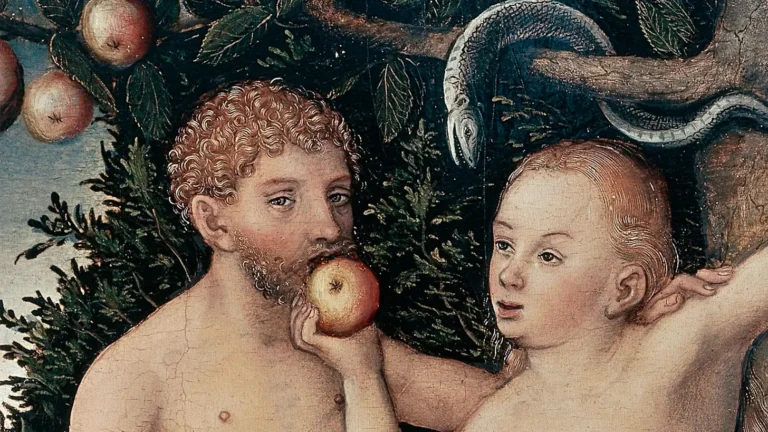
I was brought up to believe that God was an entity always there, watching every breath I take, every move I make, and if not for that, I’d run amok and do all kinds of terrible things. Without God, there’d be no morality, no decency. At some point it occurred to me that God was not keeping me from doing wrong, but that I abstained from doing wrong because God was watching, I must already be able to distinguish between right from wrong, and in that case, a sense of morality existed within me (and without God). The situation is a bit like that of the tree of knowledge of good and evil in the Garden of Eden. If Adam and Eve knew it was wrong to eat the fruit of that tree, they didn’t need to eat it to know about good and evil.
Like Adam and Eve even before they broke the world’s first restricted diet by tasting the forbidden fruit, I apparently had an innate sense of morality that didn’t come from God. He was only lurking about waiting for me to slip up. If the only reason not to do wrong is fear of punishment, it’s a weaker, more debased form of morality than not doing wrong simply because it’s wrong. If God isn’t the source of knowing what is right and wrong, but only an enforcer who rewards and punishes, He’s not much more than a cop, and it’s no more comforting to know He’s watching every breath I take, every move I make, than it is for the beloved in the song by the Police to know she’s being stalked by a creep.
If I have an innate knowledge of right and wrong, where does it come from? It’s reasonable to think it stems from a recognition that there are other human beings and they are, in many respects, like me. If I don’t like getting hit over the head, they probably wouldn’t like it either, and if I don’t like someone taking what’s mine, neither would they. We don’t need commandments from above to tell us these things—it’s comes as a consequence of living among other people. The beginning of morality is recognizing and accepting that people are alike in the most basic ways, and why wouldn’t we be since we all evolved the same way, or are all descendants of Adam and Eve?
Thinking along those lines, as well as wondering why eating a ham sandwich was a sin, led me to become an atheist. If the term agnostic didn’t seem so wishy-washy, that’s what I would have called myself, because I wasn’t giving up the idea of god, but only the God of established religions, the God at the core of all religions. Religion can’t exist without God, but god exists without religion, like morality does, and is everywhere and in everything, not a petty God who demands devotion and obedience, but a god of Being. The wind and rain, the depthless oceans and fathomless heavens, every creature from the tiniest single-celled organism to the most enormous behemoth, the tiniest particle within an atom and the boundless cosmos are all aspects of god. If we want to join a social club to schmooze, that’s fine, as long as we don’t let it obscure our innate sense of morality, but if were looking for god, we need only open our eyes and all our senses to find it in everyone, everything, and everywhere.
February, 2026