

Non-Fiction
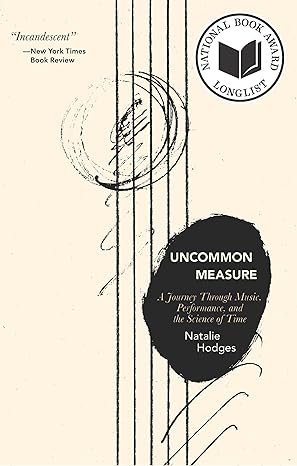
Uncommon Measure
by Natalie Hodges
I came across Natalie Hodges’ Uncommon Measure: A Journey Through Music, Performance, and the Science of Time by chance. Although it was published in 2022, I hadn’t heard of it before, and it caught my attention only when it popped up as a Big Read pick on Libby/Overdrive. The author was a violinist who decided to quit, and that interested me because a character in a novel I recently finished planned to be a concert pianist but gave up her dream, explaining to a friend:
“Remember how Chick Corea played keyboard, how fluid he was, the way the music flowed out of him? That’s what a true musician can do. I’m a proficient pianist. I can learn a piece in a reasonable amount of time and play it flawlessly. But I don’t enjoy myself while I perform. My brain is busy counting, remembering details about specific passages. When I play with other musicians, I focus on matching their tempo and cadence. There’s so much work involved and so much to keep track of that it’s exhausting. A great pianist plays with flair and passion, driven only by the music itself, the same pieces I can play only with fierce concentration. I don’t know if the music flows as naturally from them as it seems, or if they are such great showmen that they can attend to all the details that bedevil me with incredible bravado. Either way, they can do something that I cannot, and I don’t want to spend my life on a career that makes me feel I should be better at what I’m doing than I am.”
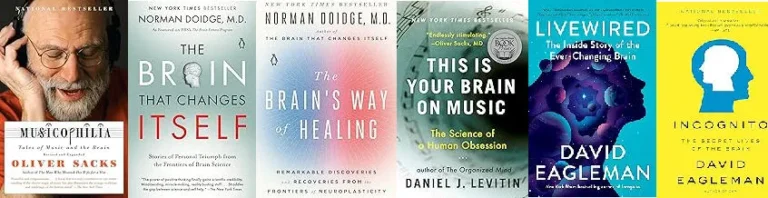
Since my fictional account was made of whole cloth and I was only trying to imagine what might cause a talented musician to change course, I was curious about Hodges’ real life experience. It also sounded like her book also explored connections between music and neuroscience, another area of interest for me. While neuroscience doesn’t sound like a very inviting topic, Oliver Sacks convinced me of how entertaining and fascinating it could be, and I read everything I could find by him with delight. I also enjoyed other neuroscience-related books such as The Brain That Changes Itself and The Brain’s Way of Healing by Norman Doidge, Daniel Levitin’s This Is Your Brain on Music, and David Eagleman’s Livewired: The Inside Story of the Ever-Changing Brain and Incognito: The Secret Lives of the Brain, and was curious about how Hodges connected music and neuroscience research. The book also promised to tell its story “from the perspective of a young Korean American,” and since my wife (and therefore, daughters) share that heritage, my interest was especially piqued, and that was even before learning that Hodges was raised in the Denver area, where we raised our children.
The book begins not with music or neuroscience, but with physics and the issue of time, which is a component of music and connected to the performance anxiety which caused her to give up on being a professional violinist. Hodges explains that the anxiety-driven performance errors she’s prone to are due to being out of time with the music, and compares what happens to her to stuttering. She discusses entrainment which she describes as “the ability to synchronize the body’s movements with a beat.” Being in time reminds me of the concept of “being in the zone” (an expression, she doesn’t use), but which is similarly characterized by suppression of self-consciousness.
Uncommon Measure is a short book that covers a great deal of ground from experiments in quantum physics to the author’s relationship with her mother and is, in effect, a memoir in which she tells her story through connected essays on a variety of subjects. I’m drawn to books and media which increase my knowledge and appreciation of things I don’t know much about. I think that’s what I like most about youtube videos by Rick Beato https://www.youtube.com/@RickBeato and Fil from Wings of Pegasus https://www.youtube.com/@wingsofpegasus, which analyze what musicians are doing. Hodges’ book has this quality. I didn’t know the stories behind Bach’s Chaconne or comprehend the complexities of playing it before, but I’m listening to Isaac Stern’s recording as I write, more aware of what he’s accomplishing. I’d never heard of pianist Gabriela Montero, but have been marveling at her incredible improvisations since reading about her in Hodges’ book. Now also I can begin to appreciate the tango as an art form and grasp its complexities.
Hodges touches on the relationship of improvisation to the default-mode network (DMN), and how it’s affected by psilocybin, something I recall reading about in Michael Pollan’s book How To Change Your Mind. I was surprised to come across a discussion between Pollan and Hodges that was arranged not because of their mutual interest in this topic, but because she was in a writing class he taught while she was attending Harvard. Since the conversation will give you a better sense of what the book is like than anything I can write, I will end by saying it was a very enjoyable read that supplied me with many new avenues to explore.
May, 2025