

Non-Fiction
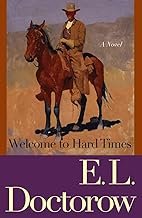
Welcome to Hard Times
by E. L. Doctorow
Writing fiction, like dreaming, is a way of processing the distressing and incomprehensible realities in our lives. Unlike dreaming, however, writing requires conscious intent and a plan or storyline of some kind. My story Rope is an attempt to contend with the catastrophic course we’re on as a nation and the calamity we’re moving toward with astonishing complacency. The story came together pretty quickly once the metaphor came to me of people cultivating hemp that would be used to produce rope that, in turn, would be used for their own annihilation.
As the story started taking shape, the mood and theme brought to mind two literary gems, Shirley Jackson’s The Lottery and E. L. Doctorow’s Welcome to Hard Times. In Jackson’s story, what starts as a festive summer day with flowers blooming and people gathering in the town square turns dark and sinister as the purpose of the ritual becomes clear. Doctorow’s novel focuses on the fragility of human society and the structures and institutions underlying it, exposing the ease with which it can all come crashing down at the hands of someone not constrained by laws, conventions, or any sense of decency. If you haven’t read Welcome to Hard Times, now would be a good time because of what this iconic piece of American Western fiction says about our current circumstances. Published in 1960, it’s a slim book, just over 200 pages, but a tough read, not because of its plot or language, but because of the brutality and futility it depicts.
Sexual violence, disregard for human life, and the gleeful destruction of the foundations of human society are the hallmarks of the Bad Man from Bodie who rides into Hard Times and wreaks havoc an the ill-fated town, and of his current day counterpart who rode into our lives on a golden escalator, boasting of grabbing women by the pussy. Before we knew it and in plain sight, he grabbed America by the pussy. Facing remarkably little resistance, he set about decimating everything that makes our society functional. Cowardice, self-interest, complacency and an inability to unite in the face of an existential threat constrain us as much as it does the denizens of Hard Times.
In Doctorow’s harrowing first paragraph, a stranger enters a packed saloon. When a floozy sidles up to him, without a word, “he reached out and stuck his hand in the collar of her dress and ripped it down to her waist so that her breasts bounded out bare.” He grins at the crowd and everyone looks away as he violently drags the woman upstairs. By the end of the chapter, she is murdered, along with a number of other townspeople, and the whole town is up in smoke. Most of the surviving residents take off to parts unknown and “the Bad Man from Bodie” responsible for the carnage rides off on a stolen horse. As I recalled it, the story was mostly about the danger posed by marauding bad men stalking struggling outposts of civilization in the old West and destroying them when the inhabitants prove incapable of uniting, fighting for, and defending what they have built. The hapless towns are snuffed out by lawless men who, in a show of shock and awe, ride in and grab what they want.
On revisiting the novel for the writing of this post, I realized, as Blue, the narrator, seems to have, that the Bad Man wasn’t the cause of all the evils that had befallen them, but the symptom of deeper societal ills. At first identified only as the Bad Man, he becomes more human and less of a concept when he’s discovered to be someone named Clay Turner. “All around,” Blue says, “the fights were going on, miners and towners trying to cripple and kill one another, hate riding their voices, gleaming on their knives, imprinted behind their running boots. And none of it had to do with Turner. He was just a man…” It wasn’t Turner who was responsible for the collapse of the town, but the decision of the mining company to call it quits. The town never had a chance. “Everything was come to nothing,” Blue broods. “You try to dispose of your life to some purpose even though it appears to have none.” Jimmy, the orphan Blue tried to raise, is destined to be another Bad Man after Clay is gone.
What caught my eye on this latest reading of the novel more than the viciousness of the Bad Man and Blue’s struggle to redeem himself after his cowardly behavior on first encountering him, was the corruption that formed the economic foundation of the town, whose lifeblood was the money miners spent on whiskey and prostitutes. The seeds for the destruction of the town weren’t sown by an outside entity but were present since its birth. That inherent rot is what summoned the Bad Man to it. What lessons are there for us? Our attention is riveted on the damage being wrought by a bad man and his minions, who were spawned by the rot within our society. If we manage to rid ourselves of the bad people now plaguing us but fail to address the fundamental ills which allowed them to emerge, we will be subject to the whims of others of their ilk once they are gone.
April, 2025