

Non-Fiction
Zohran
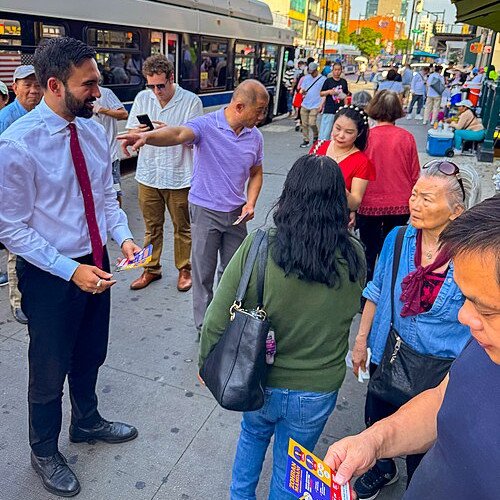
It remains to be seen what Zohran Mamdani will be able to accomplish as mayor, especially since every effort to fulfill his promises will, no doubt, be undermined by the wealthiest, most powerful people on earth, but for now, we can take satisfaction in his unlikely victory. It is a flicker of light in the darkness, a ray of hope in a time of despair. For an outsider, a Muslim, an Asian, a Social Democrat, “a complete unknown,” as Dylan might say, to become the mayor of New York, seems fantastically improbable, especially when he was opposed and demonized not only by his rivals and their backers, but by the leaders of his own party, the media, religious leaders, and even the rapper 50 Cent. His unlikely victory demonstrates the unthinkable—that people can come together and, against all odds, defeat power, money, and prejudice.
My expectations for Zohran’s success weren’t high when he began his run. As a native New Yorker, I still pay some attention to what’s going on there, and I was disgusted when Eric Adams, an awful candidate even before his criminality was on full display, trounced Maya Wiley, an intelligent and accomplished civil rights activist, in the previous election. For Zohran to come out of nowhere, with the deck stacked against him, and win the primary and the election, was an astounding feat. His idealism, authenticity, boldness, intelligence, charisma, and ability to communicate and inspire others made him a star. Unlike his opponents, he declared specific policies and goals and how he planned to achieve them. Skepticism as to whether he could overcome considerable political and logistical difficulties to make good on his promises is understandable, but who could find fault with his vision? Isn’t it to everyone’s advantage for the city to be more livable and affordable?
So why is his election being treated by VIPs, pundits, and politicians like it’s the end of the world, or at least of New York City? His agenda is, naturally, labeled radical and extreme by the GOP, cautious, conservative types scandalized by his wild and crazy ideas, accustomed as they are to the thoughtful, deliberative, uncontroversial style of the leader of their party. But why did Obama, Schumer and other top Democratic Party leaders refuse to endorse him, and Hillary treat his possible victory as a terrible eventuality? What outrages was Zohran guilty of to excite such disapproval that he was deemed more dangerous and less acceptable than a president who trampled on the constitution, turned the government into a criminal enterprise, and was hell-bent on transforming the country from a democracy to a totalitarian regime?
There seem to be two distinct lines of criticism: 1) that his fiscal policies will be disastrous and wealthy residents will flee the city; and 2) that he is bigoted toward Jews and is a threat to their safety. A third line of attack sometimes employed asserts he is too inexperienced to occupy the office of mayor, but since it is leveled primarily by those unperturbed by the qualifications of the man who occupies the White House, it’s hardly worth addressing. Zohran is also criticized for being a communist, a Marxist, and a socialist. Since he is none of those things, but a Democratic Socialist, those bandying about such labels can be dismissed as trying to sow fear and mistrust rather than presenting a serious argument.
Let’s begin with the second criticism. Although Zohran made it clear throughout the campaign that fighting bigotry, including antisemitism was one of his priorities, he was perceived by some as a danger for Jews. More than 850 rabbis (organized by an AIPAC operative) signed a letter opposing Mamdani. An eminent Conservative rabbi warned his congregation and the public that he posed a threat to their safety, and an Orthodox rabbi, a staunch supporter of a clearly bigoted, racist, and antisemitic president, denounced Zorhan for being antisemitic. After the election, the creation of a “Mamdani Monitor” to collect complaints about unfairness to Jews was announced by the president of the Anti-Defamation League in so defamatory a way that it seems the “Anti-” should be dropped from the organization’s name for the sake of accuracy. So what is the case for regarding Zohran as antisemitic?
It appears that he had the temerity, the chutzpah, to call Israel an apartheid state, but considering that Desmond Tutu, who has some knowledge of apartheid, claimed that what Israel was doing was worse than South Africa, Zohran doesn’t seem that off-base. Zohran also referred to what was happening in Gaza as a genocide, but he might be excused for that, since the same conclusion was also reached by the UN, the International Association of Genocide Scholars, the International Court of Justice, Amnesty International, Human Rights Watch, and two Israeli organizations— B’Tselem and Physicians for Human Rights-Israel, among others. One might say that those who support or condone what is happening to Palestinians now are the same kind of people who weren’t perturbed by what was happening to Jews eighty years ago. Another crime of Zohran’s was his hesitancy to condemn the phrase global intifada when pressed to do so by people (who would likely refuse to call what Israel is doing a genocide). BTW, intifada doesn’t translate to killing Jews, but uprising, which isn’t an unreasonable slogan for an oppressed people, even those committed to non-violent resistance. The charge of bigotry regarding Zohran is accurate, but he is the victim of it rather than perpetrator, and the accusations against him stem from Islamophobic bigotry masquerading as concern about antisemitism.
The criticism relating to fiscal concerns has more merit, insofar as Zohran proposes a 2% tax increase for those with an income of more than $1M per year (about 1% of filers). That is how he intends to fund free, faster buses, universal childcare, and affordable housing. We know that the super wealthy consider a grave affront any suggestion that THEIR money be used for the common good, even if they have more than can be used in a lifetime. My guess is that the whole point of having a superfluous amount of money is to be able to enjoy the privations of those in a lower economic echelon. The sight of homeless people must give them a special jolt of joy. As golden ballrooms, private jets, and luxury yachts attest, the purpose of wealth for the wealthy is not to make anyone’s life better (even their own), but to affirm their success and separate themselves from the miserable mass of humanity. I believe that impulse is ultimately due to death denial, (see The Denial of Death by Ernest Becker) a desire for immunity from the fate of other mortals. Whatever the reason, it’s clear that most of the super-wealthy prefer to use their resources to make life harder for everyone else. That’s why a gaggle of billionaires spent $22M opposing Zohran, but are loath to spend a dime to make their city more livable, and why, when the wealthy control government, as they now do, living conditions for the rest of us deteriorate.
A real democracy, conducted in the interests of the the majority, is anathema to the wealthy, because they want to be in control. They’ll use their money to buy politicians, take over institutions, and buy up the media organizations in order to misinform the public and get people to vote against their own interests. That is why they so hate and fear someone like Zohran, who has the ability to unite people. How scary it must be for them when the power of people exceeds the power of money. People like Zohran and Bernie and AOC must be vilified and prevented from getting people to realize their own power. For now, Zohran has won, but I hold no illusions that he will be allowed to carry out his agenda. His victory is a flicker of light, a breath of hope, but oh, so fragile. In the coming months we’ll see if it is extinguished or takes hold.
December, 2025