

STORIES
Reductio
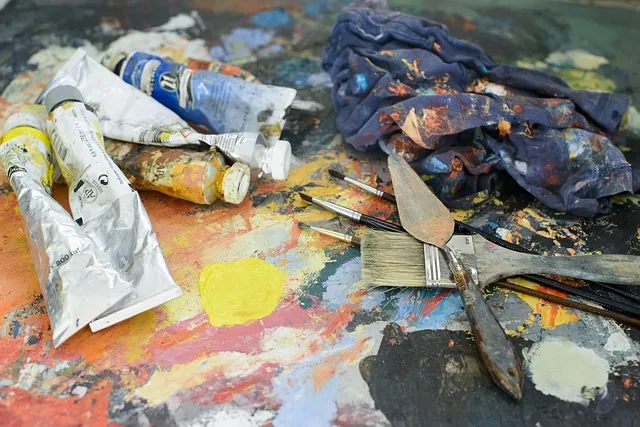
One last deft stroke and Callahan tossed his brush onto the table. Despite moments of doubt and false turns and corrections, the piece turned out exactly as it was supposed to, the inevitable culmination of a process that began as a vague idea. The picture before him had a rightness to it, like all his finished pieces, almost as if it had always existed, and all he did was unveil it. His conceit was that it had always been there and he just allowed it emerge from where it had been hidden. At the outset, he had an idea about what kind of picture he would create. No, it was more tangible than an idea, it was an image in his mind of a railroad track traversing a stretch of wilderness.
Trains and tracks were a common motif in his work, whether it was a grimy elevated track winding its way through soot-blackened brick tenements, a near-deserted platform with a lonely figure waiting for a train, or a crowded subway car filled with commuters staring with unseeing eyes. He didn’t know what drew him to trains and tracks. Perhaps it was the network of connections between distant places, or the juxtaposition of frail flesh and hard steel, or the prospect of arrivals and departures, or maybe just the indefinable mood of loneliness they conjured. It was a theme rich in emotions and possibilities. There was power in the image of the steel rails. Others would connect with it, maybe in different ways from himself, and it would have meaning.
That was the general picture in his mind as he started, without form or specificity, without life. But something guided his hand to create a certain shape, which in turn, led to another shape. The process itself was a like a train, with one element inevitably following another in the only logical way it could. All he had to do was stay on track. The colors, the perspective, the lighting would fall into place as one brush stroke followed another. Once he started, he felt less like a creator than an instrument directed by something beyond him. He just needed to let the process work, and it would take care of itself. Not that it was devoid of agony and anger. Sometimes something was out of place or didn’t work as it was supposed to. When something was wrong and the process went off the track, he felt it and reacted. In a few rare instances he abandoned a painting, but usually he found his way. He changed what was wrong, and all went well after that. Sometimes he thought his real talent was knowing when something wasn’t right.
His fellow students at the academy envied Cal’s skills. Others struggled with every aspect of composition, from laying down an accurate draft to blending colors to applying paint precisely where and how they wanted it, but he seemed to do all of those things effortlessly and was able to focus his attention on developing compelling themes and stories. He was the cause of more than one student throwing in the towel, realizing that they would never attain the level of craftsmanship that Cal seemed to have been born with. For his part, he couldn’t comprehend why others had so much difficulty with techniques that were easy for him.
He’d heard that Julian Bream performed in public for the first time as a child when his father took him to a gathering of guitar aficionados. The boy was petrified at first, but as he listened to the older musicians struggling to play what he considered easy pieces, he gained confidence. When it was his turn he played flawlessly and far better than anyone else, to the astonishment, delight and chagrin of the older musicians. They immediately recognized him as a prodigy, but he himself thought that he was simply playing his instrument, while the others seemed to be suffering peculiar impediments that kept them from doing so. That’s how Callahan felt about his peers, who had difficulties doing things that came easily to him.
It didn’t take him long to achieve critical and commercial success. His pieces sold. They were well executed without being imitative or kitschy. His canvases were pleasant to look at, yet hinted at some deeper meaning. It wasn’t unusual for gallery visitors to stand in front of a work of his for a protracted period, lost in their own thoughts. How he managed to suggest a hidden meaning behind his realistically rendered images baffled critics, and although some asserted that it was a particular trick that he used, no one could pinpoint what kind of trick it was. Artists marveled at the precision and trueness of his work. There was a consistency to his pieces that they envied. Developing a distinctive style that could be recognized as his was what many artists yearned for as ardently as budding novelists pursue a unique voice. This, too, was something that seemed to fall into Cal’s lap without his having to work for it.
He didn’t consciously choose realism. His eye for detail and his precise hand made it natural for him to be attracted to such artists as Eakins, Wyeth and Hopper and when he started drawing and painting, he naturally gravitated to their styles and subject matter. As a youngster, and in his early training, he worked hard at creating representations as realistic and accurate as possible. Like a musician practicing scales to prepare for playing real music, he assiduously practiced the techniques that seemed to him to be the building blocks for all art. He didn’t dislike abstract or impressionist art; in fact, he was quite intrigued by those genres, but he viewed them as deviations from a norm, and his focus was on achieving expertise in the norm first.
Standing back for a final inspection of the piece he had been working on all week, before cleaning his brushes, he was assailed by an uncharacteristic doubt. He examined his work carefully, looking for a false line or color. He studied it from different angles, and carried the canvas to other parts of the room to view it in different lights. Try as he might, he could find no fault in the work. It looked as it was supposed to look. The composition was good, the lines true, the colors harmonious. There was no single thing that he could find wrong with it. Yet something about it disturbed him. This had never happened before. Scratching his head he walked around his studio and looked at other pieces. They were as perfect as he deemed them when he first completed them. There was no part or piece out of place, yet they too now seemed to him lacking in some way. But how? If he added or removed any element, changed any line or hue, he was certain that the paintings would lose something important. And yet . . .
He cleaned his palette and brushes, all the while wondering what was disturbing him. Then he broke with one of his oldest routines. For years he had been in the habit of starting something new as soon as he completed a picture. It was a kind of superstition. If he went to bed without having a work in progress, he feared he might not be able to get started the following day, and maybe the day after that, and who knows for how many days. He wasn’t sure where that notion came from, probably his academy days when, with deadlines and pressure to produce, he came to hate staring at the void of an empty canvas. He discovered that it wasn’t hard to start a new piece right after completing a painting, for although he was tired, he was contented and relaxed. His critical filters were subdued and his imagination free to play. If he didn’t like what he painted, he could always make changes later, but more often than not, the work he did in this state proved a good foundation to build on. At least he had a starting point and didn’t have to begin a new day with a blank canvas.
But now he wasn’t ready to start a new piece. He was too unsettled. He couldn’t focus on something new when his mind was still occupied by a sensation of incompleteness. So, he pulled a chair up in front of his easel and sat there gazing at his latest painting. He was no longer looking for an error. He had already done that and couldn’t find anything wrong. He wasn’t inspecting it critically but looking at it with a blank mind. Normally, contemplation of one of his paintings afforded him a feeling of satisfaction, a sense that he had completed a puzzle with all the pieces in place in the only possible way they could go together. That feeling was absent. He wasn’t upset, but confused, as he would be if he looked out his window and saw, instead of the familiar street and trees, a completely different landscape from another country or planet. He was curious about the uncharted territory he found himself in.
His eyes opened and his mouth gaped wide in a yawn. He had fallen asleep in his chair in front of the painting. Upon waking he felt energized. He knew exactly what to do. He washed his face, made a fresh pot of coffee and ate a quick breakfast. Then he went to work. He took his brush to the perfect painting and worked frenetically, undoing the meticulous precision of what he had done earlier. His strokes weren’t directed by his mind but by intuition. He worked until his body made him aware of how tired and hungry he was. Stepping back he examined his revised painting. The result amused him. What he saw was familiar and new at the same time.
His realistic representation had been transformed into a hazy, impressionistic dream, the way a scene by Courbet would look if it was re-painted by Renoir. Cal had been intrigued upon hearing of underpaintings, discovered by means of advanced x-ray techniques, below the surface of masterpieces by Goya, Degas and others. He imagined that the hitherto unknown painting beneath the paintings, invisible to the naked eye, imbued them with a depth and richness that the viewer felt without seeing. Maybe his own piece had now been enriched in this way. Cal derided those who thought they knew a painting when all they had seen was a print. They didn’t understand that a canvas possesses depth and a unique history absent in a reproduction.
Never content with producing the same thing over and over again, Cal wished to accomplish something new with each new piece. The difference between an artist and a craftsman, he thought, was that the latter honed his skills in order to reproduce with precision something created before. A master craftsman, like a machine, was able to replicate over and over again the same exact object. He didn’t denigrate that skill, but regarded himself as an artist, driven not to duplicate but to delve further each time and produce something new. For Cal, craftsmanship was a tool, like his brushes and paints, to achieve his creative goals.
He didn’t allow his style remain static, but constantly experimented as he pushed his art further. Up to now, however, all his development was in one direction—refining and making more exact and meaningful each brush stroke. This was the first time he moved in a completely different direction, making his representation less clear, less distinct. At first, he feared his alterations would disfigure his work. In fact, the new version was different from what he started with, but still perfect in its own way. The piece was complete and he could go on to something else. But something still bothered him. It wasn’t an error he had to correct but somewhere further he could go to satisfy his creative urge.
When he began work the next day, a simple idea drove his actions—remove every trace of realism from the canvas. It was as radical a notion for one who understood art as a representation of the real world. But now it seemed to him that that perspective was exactly what was holding him back and imposing limits on his creativity. His realistic paintings used the world of real things to support what he was trying to convey, and his impressionistic version was no less dependent on known reality. The real objects he painted served as a crutch for people to understand his art, just as lyrics do in music. Words and their meaning diluted and diminished the purity and power of music. He didn’t want his art understood—he wanted it felt.
He would express himself without using known objects, without invoking comprehension. He had to translate his piece from something aimed at the intellect to something that touched the soul. This was a much harder task than moving from realism to impressionism, and he struggled to deconstruct his previous vision, using color and form to express feelings and sensations that he formerly expressed through comprehensible scenes. He changed his palette over and over again, seeking new colors. Brushes, knives, his fingers, he used whatever he could to create textures that gave the piece new depth. He worked relentlessly all day long, and when he finished he was so exhausted he could barely stand. Without pausing to examine the canvas, he staggered to his bed and fell sound asleep.
In the morning he went straight to his painting, half afraid of what he would see. The canvas on the easel took his breath away. It evoked strong feelings in him and although he couldn’t articulate what those feelings were, he recognized that he was accomplishing something important. He was on the right track, and even if he wasn’t quite there yet, he was getting closer. He grabbed some leftovers from the fridge and laid them out on the kitchen table, but after taking a few bites, he jumped up, grabbed the canvas and propped it up opposite his chair.
As he sat gazing at his painting, he thought about how it started out and the transformations it had undergone. In a way, it mirrored the history of western art, moving from realism to impressionism to abstract art. In an anatomy class he took to better understand and draw the human form, he heard the phrase ontogeny recapitulates phylogeny, meaning that as an embryo develops, it traces the evolution of the species. He smiled at the thought that the evolution of his painting traced the history of art. But the evolution wasn’t complete. He had more to do.
There were still extraneous elements that had to be eliminated. He didn’t know where the inspiration had come from, but he was certain that the key to completing his work lay in paring it down to its bare essentials. He placed it back on the easel. Brush in hand, he went to work, starting out tentatively by removing a line here and there. Each time something disappeared, he discovered other things that were no longer necessary. He worked in a fury now, excited by the deeper truth he sought, ridding his work of everything unnecessary. Finally, he stepped back to view his work, a composition painstakingly purged of all unnecessary lines and colors. A crazy smile broke out on his face as he gazed at his masterpiece bathed in the fading light of the setting sun. It was all he could have hoped for, an expanse of pure and pristine white, almost as perfect as a blank canvas.
September, 2025